
Drug and Alcohol Rehab Serving Denton, Texas
Denton is the Denton County seat and home to the University of North Texas and Texas Woman’s University. It is also roughly 40 miles from our nearest outpatient program, and that distance is worth being honest about from the start.
Discovery Point Retreat does not have a facility in Denton. What we offer Denton residents is outpatient addiction treatment at our Dallas location on Capitol Avenue, down I-35E. At rush hour that drive runs about 55 minutes to an hour and 40 minutes each way, so two options are worth looking at first: evening IOP, which meets from 4 to 7 pm or 6 to 9 pm, and living in one of our Dallas sober living homes during treatment, which include daily transportation to and from the program. We also offer a partial hospitalization program (PHP) and a daytime intensive outpatient program (IOP). Medical detox and residential care are provided only at our facilities in Ennis and Waxahachie, south of Dallas.
If you are weighing whether a Dallas program is workable from Denton, call (855) 245-7133 and talk it through. Our admissions team answers twenty-four hours a day. The call is confidential, and calling does not commit you to anything.
WHAT OUTPATIENT CARE IN DALLAS LOOKS LIKE FROM DENTON
Outpatient treatment means you attend structured sessions and then go home. From Denton, the commute is part of the decision, so it helps to look at each level of care with the drive in mind. Which level fits depends on what a clinician recommends after your evaluation.
Partial hospitalization program (PHP). Structured daytime treatment on several days a week, with more support than IOP. It is meant for people who need close support but not a residential stay, including people stepping down from detox or residential care. PHP usually means time away from work, depending on your schedule and treatment plan. How long someone stays depends on that plan.
Daytime IOP. Fewer hours than PHP, a few hours at a time on several days a week.
Evening IOP, 4 to 7 pm or 6 to 9 pm. Evening IOP may fit some work schedules, depending on your hours and treatment plan. From Denton, the 6 pm group gives you more room to finish work and make the drive. Plan on about an hour to an hour and 40 minutes on I-35E at that time of day.
PHP and IOP include weekly one-on-one therapy, group therapy, and relapse prevention planning, and clients who step down from PHP to IOP keep the same care team. If the daily round trip from Denton is the main obstacle, ask about our Dallas sober living homes. They are for people enrolled in our program, and they include daily transportation to and from treatment.
DRIVING OR TAKING THE A-TRAIN FROM DENTON
By car. The usual route is I-35E south through Lewisville and Carrollton toward downtown Dallas and our Capitol Avenue location, about 41 miles. At weekday rush hour, plan on 55 minutes to an hour and a half for an 8 am departure, and an hour to an hour and 40 minutes at 5 pm. The tolled I-35E Express lanes can save time in the evening. Outside rush hour, the drive is roughly 45 to 60 minutes. Morning IOP runs 9 am to noon, and PHP runs 9 am to 3 pm, so a daytime program from Denton means an early start every day.
By rail. Denton is not a DART member city. It is served by the Denton County Transportation Authority (DCTA), whose A-train has two Denton stations: the Downtown Denton Transit Center and MedPark Station. DCTA says the A-train runs Monday through Saturday, excluding major holidays, so there is no Sunday rail service. One possible rail route is the A-train south to Trinity Mills Station in Carrollton, the DART Green Line into downtown Dallas, then a northbound DART train to Cityplace/Uptown Station, followed by a walk or rideshare to our location. That is two transfers and a long trip, so it may not be practical for daily program hours. Check DCTA’s A-train page and DART’s current schedules and service alerts before you travel, and our admissions team can help you plan the trip.
DRUG REHAB FOR DENTON, TX RESIDENTS
Drug problems do not follow one script. For one person it starts with pills from a friend during a hard semester. For another it is a stimulant used to stay awake through deadlines, opioids that outlasted an injury, or cocaine and alcohol that keep showing up together. More than one substance may be involved.
Fentanyl raises the stakes. It turns up in pressed pills made to look like real medication, which means any pill that did not come from a pharmacy carries a risk you cannot see.
During an evaluation, a clinician may ask about the substance, how long and how much you have been using, your mental health, your living and work or school situation, and any past treatment. Depending on that assessment, the starting point may be PHP or IOP at our Dallas location, or medical detox and residential care at our Ennis or Waxahachie facility first if that is safer. You can ask questions and take time before deciding.
UNT students. The University of North Texas runs a Collegiate Recovery Program that offers recovery meetings, peer mentoring, and referrals for students in recovery. It is campus support, not treatment, and it can sit alongside an outpatient program.
Call (855) 245-7133 to start that conversation. The first call is free and confidential.
ALCOHOL REHAB FOR DENTON, TX RESIDENTS
For some people, drinking stays occasional. For others it slowly becomes the way every week ends, then the way every day ends. Because drinking is so normal at games, parties, and dinners, it can take a long time for anyone to say out loud that it has become a problem.
Some signs worth paying attention to: morning drinks to settle your nerves, promising yourself a dry week and not making it past day two, blacking out, or friends and family starting to keep track for you.
Stopping suddenly after heavy, long-term drinking can be physically dangerous, with risks that include seizures and delirium tremens. We do not recommend detoxing from alcohol at home. If someone in withdrawal has a seizure, severe confusion, hallucinations, a high fever, or an irregular heartbeat, call 911. If you need detox, it happens under medical supervision at our Ennis or Waxahachie facility. Afterward, some people continue in PHP or IOP at our Dallas location while living at home in Denton. Call (855) 245-7133 to talk through what that could look like for you.
WORK, SCHOOL, AND FAMILY
Work. If PHP is recommended, ask HR confidentially about protected leave or an employee assistance program. If your hours change week to week, mention that on the first call so our team can talk through realistic options.
School. If you are a student and treatment will affect your classes, your school’s dean of students office can explain what options exist. We only coordinate with employers, schools, or family members with your written consent.
Family. When a parent is in Dallas or Fort Worth and a son or daughter is in Denton, or the other way around, distance can make it hard to know how to help. Ask our admissions team how family members can be involved. Any family participation depends on the treatment plan and on the consent of the person in treatment.
PAYING FOR OUTPATIENT TREATMENT
Cost depends on the level of care, how long you are in treatment, and the details of your insurance plan. Discovery Point Retreat works with many major insurance carriers and will verify your benefits before you start, so you know what your plan covers for PHP or IOP. Coverage varies by plan. Discovery Point Retreat does not accept Medicare or Medicaid.
To check your plan, call (855) 245-7133 or use our insurance verification page. Students on a parent’s plan can still have benefits checked. If you are uninsured or your plan does not cover treatment, ask our admissions team about self-pay options.
CRISIS AND COURT RESOURCES IN DENTON COUNTY
Crisis line. Denton is in Denton County, where the local mental health authority is Denton County MHMR Center. Its crisis line is 1-800-762-0157. You can also call or text 988. In a medical emergency, call 911.
Specialty courts. Denton County runs court-supervised programs that pair accountability with treatment. See the county’s specialized treatment court programs. If you are in one of these programs or on probation, talk with your supervision officer before choosing a provider, and tell our admissions team what the court requires so we can tell you honestly whether our outpatient program fits.
Peer support. Mutual support meetings are held across Denton and the surrounding area. Your care team can help you find meetings near home, work, or campus as part of your recovery plan.
WHEN DETOX OR RESIDENTIAL CARE COMES FIRST
Outpatient care is not always the safe first step. A clinician may recommend medical detox or residential treatment first for heavy, long-term alcohol use, benzodiazepine or opioid dependence, or when someone has tried outpatient treatment before and relapsed.
Discovery Point Retreat provides detox and residential care at our Ennis and Waxahachie facilities. When that stage is done, some people continue with PHP or IOP at our Dallas location. Our team can talk with you about transition planning before detox or residential care ends.
SOBER WAYS TO SPEND TIME IN DENTON
Recovery frees up evenings and weekends that used to go somewhere else. A few city-run places in Denton to put some of that time:
Clear Creek Natural Heritage Center, 3310 Collins Rd, Denton, Texas
The city describes it as a gateway to more than 2,900 acres of bottomland forest, prairie, and wetland habitat, with more than 10 miles of hiking trails. Some people find time outdoors helpful in early recovery. Trails can close after bad weather, so check conditions before you go.
Denton Firefighters Museum, 332 E Hickory St, Denton, Texas
A small museum in the lobby of the historic Central Fire Station, run by the Denton Fire Department. Call ahead to confirm visiting hours.
Quakertown Park, 700 Oakland St, Denton, Texas
A city park behind the Denton Civic Center with walking paths and open green space, a few blocks from the downtown square. A good spot for a short, regular walk.
DENTON OUTPATIENT REHAB FAQ
Is there a Discovery Point Retreat facility in Denton?
No. Denton residents attend outpatient programs at our Dallas location on Capitol Avenue. Detox and residential care are at our Ennis and Waxahachie facilities.
How long is the drive from Denton to the Dallas location?
Roughly 40 miles down I-35E. At weekday rush hour, about 55 minutes to an hour and 40 minutes each way. Outside rush hour, about 45 to 60 minutes. If that is too much to do every day, ask about our Dallas sober living homes, which are for people in our program and include daily transportation to and from treatment.
Can I get to treatment from Denton without a car?
It is possible but long. One possible route is the DCTA A-train from the Downtown Denton Transit Center or MedPark to Trinity Mills, the DART Green Line into downtown Dallas, then a northbound DART train to Cityplace/Uptown Station, followed by a walk or rideshare. The A-train does not run on Sundays. Check DCTA and DART schedules before you travel.
Which crisis line serves Denton?
Denton County MHMR Center at 1-800-762-0157. You can also call or text 988 from anywhere. In a medical emergency, call 911.
We’re Here When You’re Ready
You do not need to have the commute, the schedule, or the insurance figured out before you call. Call (855) 245-7133 to speak with our admissions team. The call is confidential, and you choose what happens next.
If a phone call feels like too much right now, use the contact form on our website and someone from our team will reach out.
Learn more about care for people from Denton: visit our Dallas outpatient location, read about our evening IOP and levels of care, or see how to check your insurance coverage.


Holding the Gains: What Outpatient Care After Residential Treatment Looks Like in Dallas
Quick Summary: Finishing residential treatment is a big step, but going home is where recovery gets tested. Discovery Point Retreat’s Dallas outpatient program, which includes
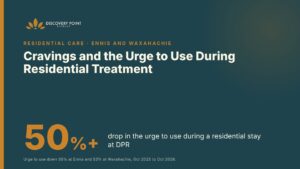
Cravings and the Urge to Use: What Changes During Residential Treatment
Quick Summary: Cravings are one of the most common reasons people feel stuck in early recovery. Between October 2025 and October 2026, adults in Discovery
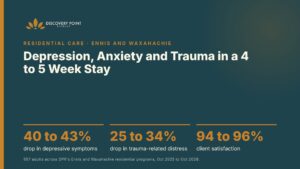
Depression, Anxiety and Trauma Symptoms During a Residential Stay: Our Ennis and Waxahachie Results
Quick Summary: Many people who enter addiction treatment are also carrying depression, anxiety or trauma. Between October 2025 and October 2026, adults in residential treatment
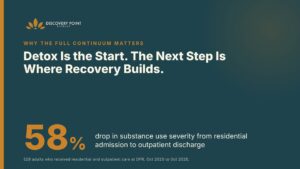
Why Detox Is Only the Start: What a Year of Continuum Data Shows
Quick Summary: Detox helps the body get through withdrawal safely, but it does not treat the habits, stress, cravings and mental health issues that drive

How Much Does Rehab Cost? What Drives the Price and How to Pay for It
Quick Summary There is no single price for rehab. What you pay depends mostly on the level of care, how long you stay, and what
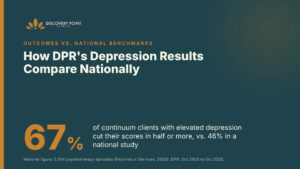
How Discovery Point Retreat’s Depression Results Compare to a National Benchmark
Quick Summary: A large national study of 5,554 psychotherapy episodes found that 46% of patients with elevated depression cut their depression scores in half. Among