Quick Summary: Detox helps the body get through withdrawal safely, but it does not treat the habits, stress, cravings and mental health issues that drive substance use. National research shows the step from detox into further treatment is often missed. At Discovery Point Retreat, adults who moved from residential care into outpatient care between October 2025 and October 2026 saw substance use severity drop 58% and overall distress drop 43%. Here is what that continuum looks like and why it matters.
Key Takeaways
- Detox manages withdrawal. It is the first step of treatment, not the whole thing.
- A national study of about 271,000 inpatient drug detox hospitalizations found that only 13% included rehabilitation during the hospital stay.
- DPR clients who moved from residential care into outpatient care saw substance use severity fall 58%, with 81.6% improving.
- Cravings fell 58% and the urge to use fell 64% across the full continuum.
- The same weekly survey follows each client from detox through outpatient care, so nothing gets lost in the hand-off.
What Detox Does, and What It Does Not
Medical detox is about safety. When someone has been drinking heavily or using drugs regularly, the body adapts. Stopping can bring on withdrawal symptoms that range from miserable to dangerous, especially with alcohol and sedatives. A supervised detox lets a medical team watch for complications and keep the person as comfortable and safe as possible.
What detox does not do is change the reasons someone was using in the first place. It does not teach new ways to handle stress, repair relationships, treat depression or anxiety, or build a plan for the weeks after. That work happens in the next stages of care.
Where People Fall Through the Cracks
The step after detox is one of the weakest links in addiction care nationally.
A study published in BMC Public Health analyzed about 271,000 inpatient drug detox hospitalizations from 2003 to 2011. Only 13% of those hospitalizations included rehabilitation during the inpatient stay. The researchers described a “potentially large detoxification-treatment gap” and called for better ways to help patients engage in further treatment.
In plain terms, a lot of people get through withdrawal and then go home without the next step lined up. That is the gap a continuum of care is built to close.
What a Continuum of Care Looks Like at DPR
At Discovery Point Retreat, detox is the front door to a full program rather than a stand-alone service. A typical path looks like this:
- Detox, when needed, to get through withdrawal safely.
- Residential treatment at our Ennis or Waxahachie facility, usually four to five weeks, with daily therapy and structure.
- Partial hospitalization (PHP) and intensive outpatient care (IOP) at our Dallas outpatient program, usually nine weeks or more, while clients start living at home and returning to daily life.
The same clinical survey follows each client through all three stages. Clients fill it out every week, and the care team uses the results to adjust treatment as they go.
What the Continuum Data Shows
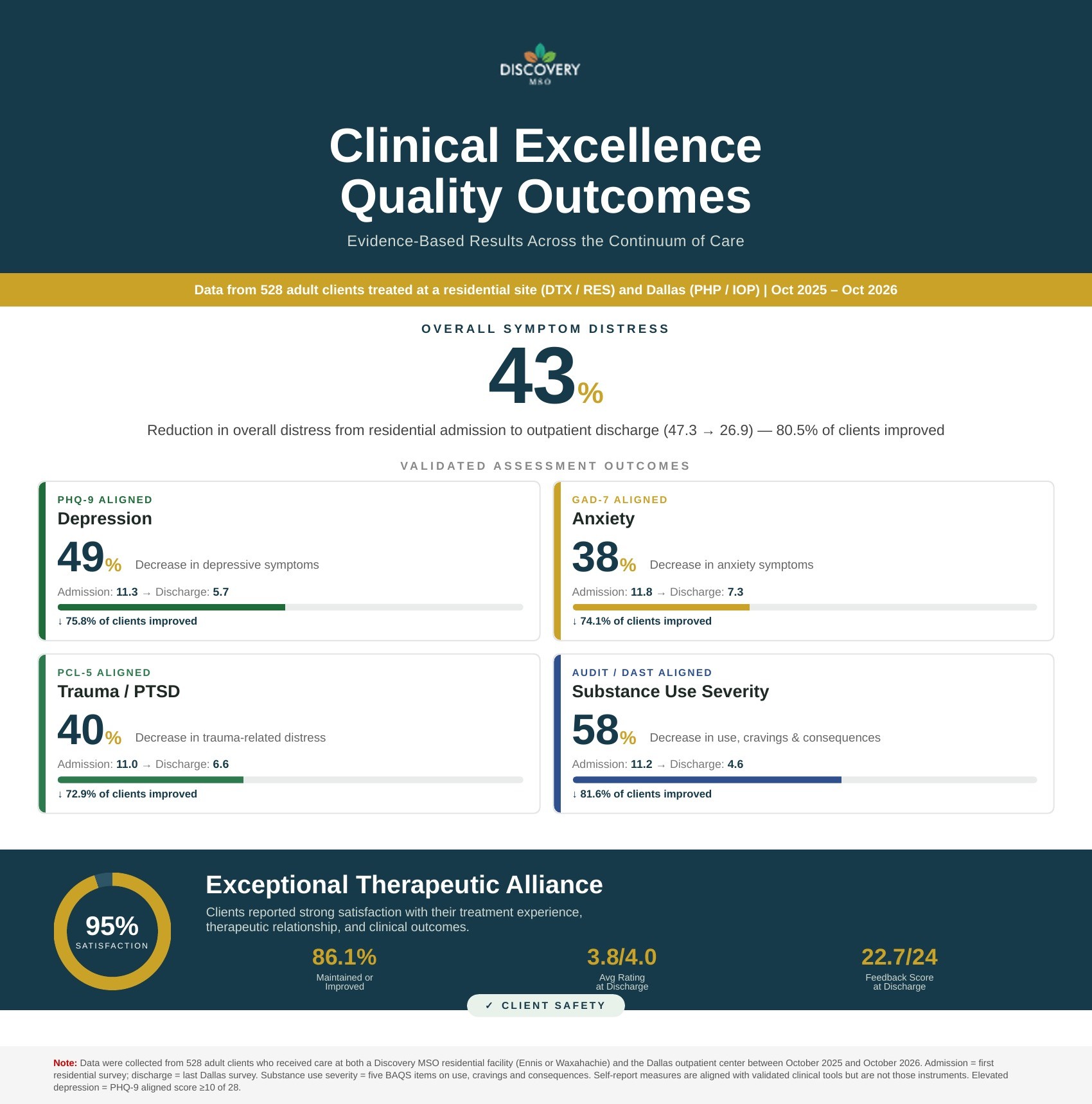
Between October 2025 and October 2026, 528 adults received residential care at Ennis or Waxahachie and then stepped down to outpatient care in Dallas. From their first residential survey to their last outpatient survey:
- Substance use severity fell 58%, from an average of 11.2 to 4.6, and 81.6% of clients improved. This measure combines use, cravings and the consequences of use.
- Cravings fell 58% and the urge to use fell 64%.
- Problems tied to use, at work, school and home, fell 64%.
- Overall distress fell 43%, and 80.5% of clients improved.
- Depressive symptoms fell 49%, anxiety fell 38% and trauma-related distress fell 40%.
- Recovery engagement, which reflects peer-group acceptance and participation in a sober lifestyle, rose 26%.
These numbers are larger than what either residential facility reports on its own, and that is the point. They cover a longer stretch of care. Residential treatment helps people stabilize. Outpatient care gives them time to practice what they learned with support still close by.
Why the Hand-Off Matters So Much
Leaving residential care is a big moment. People go from a structured, supported setting back into the same neighborhoods, jobs and relationships where use used to happen. Stepping down to PHP or IOP keeps treatment going during that transition, with therapy several days a week and a team that already knows the client’s history.
Because DPR uses one survey across every level of care, the outpatient team can see exactly where each client left off. They do not start from scratch, and the client does not have to retell their story to a brand new program.
If you are comparing programs, ask what happens after detox. Ask whether the next step is set up before discharge, and whether the same records and measures follow you. Those answers tell you a lot about how a program handles the hardest part of early recovery.
About this data: These results cover October 2025 through October 2026. Clients complete the same weekly self-report survey at every level of care. Its questions are aligned with widely used clinical screening tools, but it is DPR’s own instrument and not those tools themselves. The data was collected by Discovery Point Retreat, LLC, verified by Discovery MSO, LLC, and prepared for clinical review by Lauren Reisman, LMSW, and Dr. Jerry Vaccaro, M.D. The results reflect self-reported symptoms and day-to-day functioning. They are not sobriety or relapse rates, and individual results vary.
When to Reach Out for Help
It may be time to talk with someone if you or a person you care about is drinking or using more than planned, has tried to cut back and could not, feels strong cravings, needs more to get the same effect, or is running into problems at work, at home or with the law because of use. Feeling sick, shaky, anxious or unable to sleep when you stop is another sign that your body has adapted, and it is a good reason to get a medical opinion.
If you drink heavily or take sedatives such as benzodiazepines every day, do not stop suddenly without medical advice. Withdrawal from alcohol and sedatives can be dangerous, and a medically supervised detox is the safer way to stop.
If you or someone you know is in emotional crisis, call or text 988. If anyone is in immediate danger or cannot stay safe, call 911 or go to an emergency department.
If someone has stopped breathing, cannot be woken or may have overdosed, call 911, give naloxone if available, and stay with the person until help arrives.
Talking With a Professional
A good first call is mostly questions, and you are allowed to ask them. Ask how the program measures progress, how often it checks in with clients, and who reviews the results. Ask what happens when one level of care ends and the next one starts, and whether the same team and the same records follow you. Ask about cost and coverage up front. Our guide on how to verify your insurance benefits before rehab walks through the questions to ask your plan.
Our admissions team can talk through what you are dealing with, explain the difference between detox, residential and outpatient care, and help you figure out which level of care makes sense to start with. Ask which services are currently available at each location, since programs and schedules can change. You can reach the team online or by phone any time.
Frequently Asked Questions
Is detox enough to treat addiction?
Detox manages withdrawal safely, but it does not address the reasons behind substance use, such as stress, mental health conditions or habits. Most people benefit from continued treatment, such as residential or outpatient care, after detox.
How long is the full program at Discovery Point Retreat?
A typical path is four to five weeks of residential treatment followed by nine or more weeks of PHP and IOP. Length of care depends on each person’s needs, so ask the admissions team what makes sense for your situation.
What does substance use severity measure?
In DPR’s survey, substance use severity combines questions about use, cravings and the consequences of use. Across the full continuum it fell 58% between October 2025 and October 2026.
Does DPR offer detox on its own?
DPR’s detox is designed as the first step of a full program. Ask the admissions team which services are currently available at each location.
Is it safe to stop drinking on my own?
If you drink heavily every day, stopping suddenly can be dangerous. Talk with a medical provider before you stop, and consider a supervised detox.
References
- Zhu, H., and Wu, L.-T. “National Trends and Characteristics of Inpatient Detoxification for Drug Use Disorders in the United States.” BMC Public Health, 2018. Accessed October 2026. pubmed.ncbi.nlm.nih.gov
Related Reading
- Medical detox at Discovery Point Retreat
- Residential inpatient treatment
- Outpatient addiction treatment in Dallas
- What to expect in addiction recovery
- What to bring to rehab: a checklist
Resources
- 988 Lifeline: call or text 988, any time
- SAMHSA National Helpline: 1-800-662-HELP (4357), free, confidential, 24/7 treatment referral and information
- Emergencies: call 911
This article is general education and is not medical advice.
If you are ready to talk about treatment for yourself or someone you love, call Discovery Point Retreat at (855) 245-7133 or contact our admissions team online. We can walk you through detox, residential and outpatient options and help you take the next step.