Quick Summary: Cravings are one of the most common reasons people feel stuck in early recovery. Between October 2025 and October 2026, adults in Discovery Point Retreat’s residential programs reported the urge to use falling 50% at Ennis and 53% at Waxahachie, with cravings falling 46% and 49%. This post explains what cravings are, why they ease with treatment, what our data shows and what helps after residential care ends.
Key Takeaways
- Cravings and urges are normal in early recovery. They are a sign the brain is still adjusting, not a sign of failure.
- At Ennis, the urge to use fell 50% and cravings fell 46% during a typical four to five week stay.
- At Waxahachie, the urge to use fell 53% and cravings fell 49% over the same kind of stay.
- Feelings of hopelessness and worthlessness also dropped by roughly 40% to 50% at both facilities.
- Across the full residential and outpatient continuum, cravings fell 58% and the urge to use fell 64%.
What Cravings Are
A craving is a strong pull toward drinking or using. It can show up as a physical feeling, a thought that will not go away or a sudden rush of “just this once.” Urges often get triggered by people, places, moods or routines tied to past use: payday, a certain drive home, an argument, a long day.
None of that means someone is doing recovery wrong. After a long stretch of regular use, it takes time and practice for that pull to fade. The National Institute on Alcohol Abuse and Alcoholism’s guide to handling urges to drink lists practical strategies such as avoiding triggers, leaving a risky situation, talking it through with someone and riding the urge out.
Why Cravings Ease in Treatment
Residential treatment changes a lot at once. People are out of the environments where use happened. They have structure, sleep and regular meals. And they spend each day learning practical skills for handling urges, like:
- Spotting personal triggers before they turn into urges
- Riding out a craving instead of acting on it
- Calling on peers or staff when a craving hits
- Dealing with the stress, anxiety or low mood that often sits under an urge
Treating mental health alongside substance use matters here too. When depression and anxiety ease, there is often less pressure behind the urge to use. DPR treats co-occurring mental health conditions as part of every residential plan.
What Our Data Shows
Every client at DPR fills out the same weekly self-report survey, which includes questions on cravings, the urge to use and the consequences of use. The numbers below compare each client’s first residential survey with their last one, during a stay that typically lasts four to five weeks.
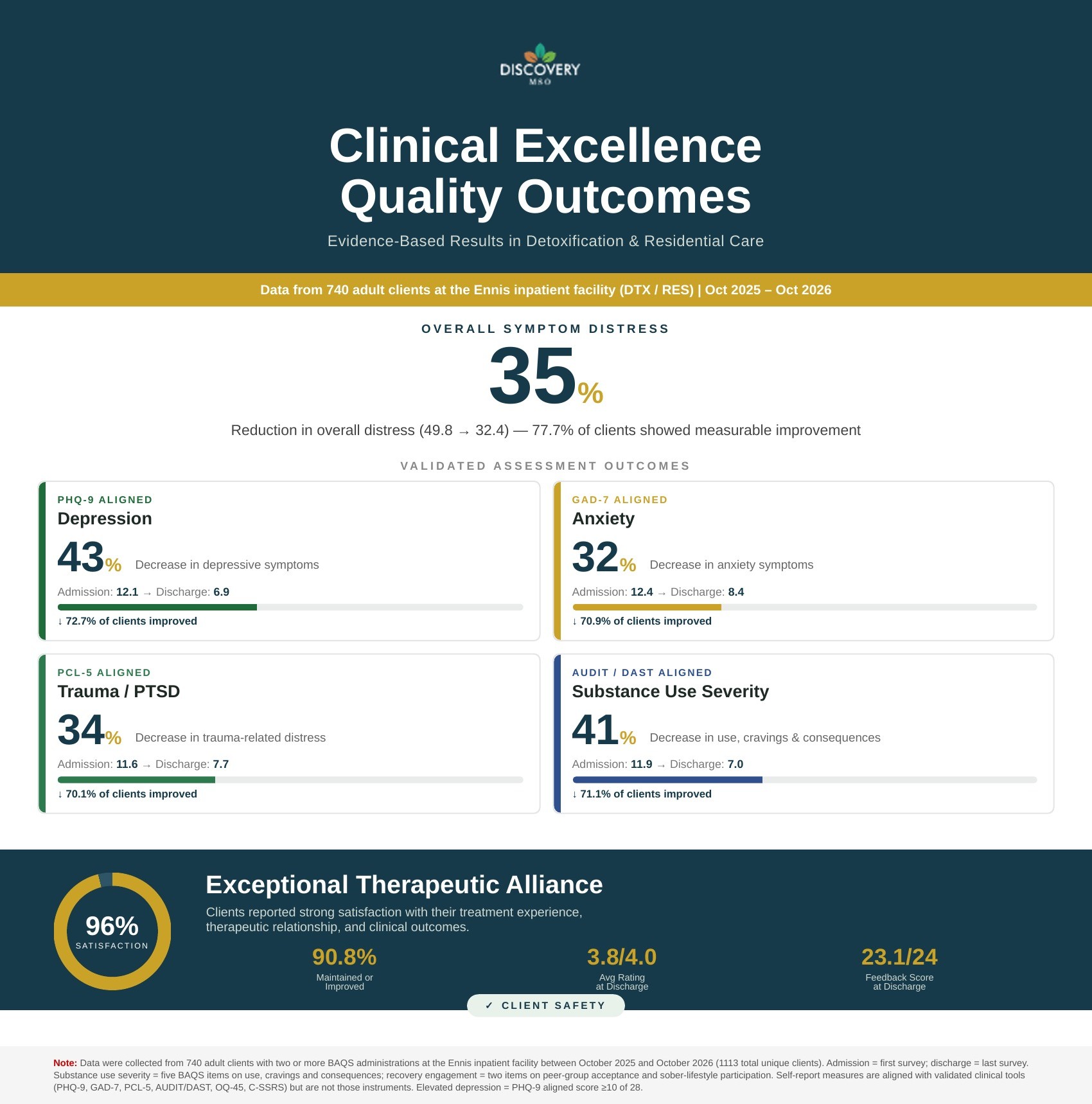
Ennis, 740 adults with paired surveys:
- Urge to use fell 50%
- Cravings fell 46%
- Consequences of use fell 40%
- Overall substance use severity fell 41%, and 71.1% of clients improved
- Hopelessness fell 47% and worthlessness fell 46%
- Recovery engagement, meaning peer-group acceptance and participation in a sober lifestyle, rose 29%
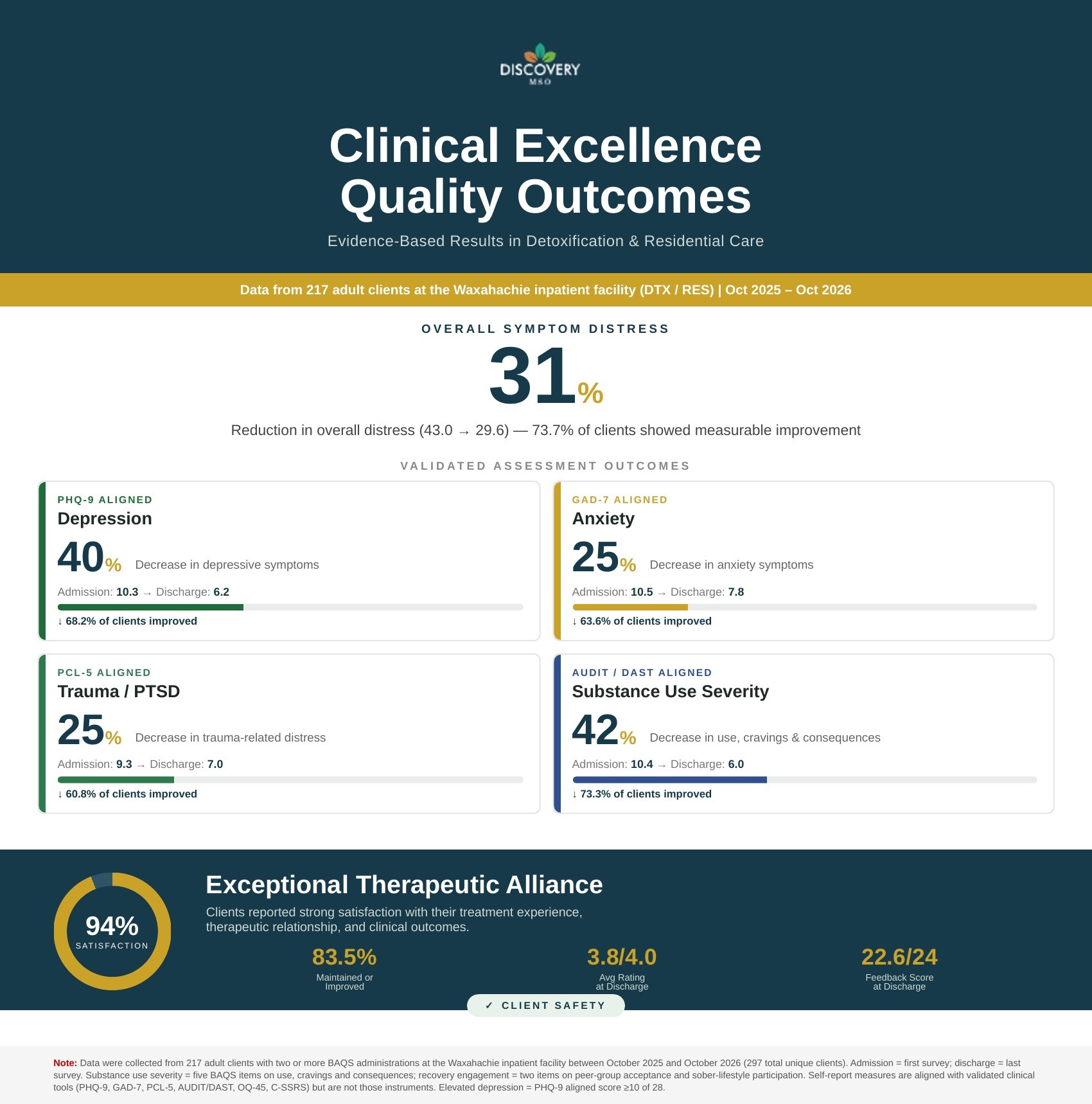
Waxahachie, 217 adults with paired surveys:
- Urge to use fell 53%
- Cravings fell 49%
- Consequences of use fell 42%
- Overall substance use severity fell 42%, and 73.3% of clients improved
- Hopelessness fell 39% and worthlessness fell 48%
- Recovery engagement rose 30%
Why Hopelessness Matters Here
The drop in hopelessness and worthlessness may be the most important part of this picture. Those feelings are closely tied to motivation. When someone believes things can get better and that they are worth the effort, it is easier to stay with treatment and to say no to an urge. Seeing those scores fall alongside cravings tells us clients are not just white-knuckling it. They are starting to feel differently about their lives.
What Happens After Residential Care
Cravings do not disappear the day someone leaves residential treatment. Going home means facing old triggers again, and that is when ongoing support matters most.
Many DPR clients step down to partial hospitalization or intensive outpatient care at our Dallas outpatient program, where they keep working on these skills several days a week while living at home. For the 528 adults who received both residential and outpatient care between October 2025 and October 2026, cravings fell 58% and the urge to use fell 64% from residential admission to outpatient discharge.
A few things that help outside of treatment:
- Keep a short list of people you can call when an urge hits, and actually call them
- Plan ahead for high-risk times and places
- Stay connected to a peer group or recovery community
- Look after the basics: sleep, regular meals and stress
- Tell your care team if cravings are getting stronger instead of weaker
About this data: These results cover October 2025 through October 2026. Clients complete the same weekly self-report survey at every level of care. Its questions are aligned with widely used clinical screening tools, but it is DPR’s own instrument and not those tools themselves. The data was collected by Discovery Point Retreat, LLC, verified by Discovery MSO, LLC, and prepared for clinical review by Lauren Reisman, LMSW, and Dr. Jerry Vaccaro, M.D. The results reflect self-reported symptoms and day-to-day functioning. They are not sobriety or relapse rates, and individual results vary.
When to Reach Out for Help
It may be time to talk with someone if you or a person you care about is drinking or using more than planned, has tried to cut back and could not, feels strong cravings, needs more to get the same effect, or is running into problems at work, at home or with the law because of use. Feeling sick, shaky, anxious or unable to sleep when you stop is another sign that your body has adapted, and it is a good reason to get a medical opinion.
If you drink heavily or take sedatives such as benzodiazepines every day, do not stop suddenly without medical advice. Withdrawal from alcohol and sedatives can be dangerous, and a medically supervised detox is the safer way to stop.
If you or someone you know is in emotional crisis, call or text 988. If anyone is in immediate danger or cannot stay safe, call 911 or go to an emergency department.
If someone has stopped breathing, cannot be woken or may have overdosed, call 911, give naloxone if available, and stay with the person until help arrives.
Talking With a Professional
A good first call is mostly questions, and you are allowed to ask them. Ask how the program measures progress, how often it checks in with clients, and who reviews the results. Ask what happens when one level of care ends and the next one starts, and whether the same team and the same records follow you. Ask about cost and coverage up front. Our guide on how to verify your insurance benefits before rehab walks through the questions to ask your plan.
Our admissions team can talk through what you are dealing with, explain the difference between detox, residential and outpatient care, and help you figure out which level of care makes sense to start with. Ask which services are currently available at each location, since programs and schedules can change. You can reach the team online or by phone any time.
Frequently Asked Questions
Are cravings normal in early recovery?
Yes. Cravings are a common part of early recovery and are something treatment works on directly. Having a craving does not mean treatment is failing.
Do cravings go away?
For many people, cravings become easier to manage with time, treatment and practice, though triggers can still bring them up. In DPR’s data, cravings fell by nearly half during a residential stay. Ongoing support after treatment helps.
How much did cravings drop at Discovery Point Retreat?
Between October 2025 and October 2026, cravings fell 46% at Ennis and 49% at Waxahachie during residential stays. The urge to use fell 50% and 53%.
What should I do if a craving hits after treatment?
Reach out to someone you trust, leave the situation if you can, and ride the urge out. If cravings are getting stronger or more frequent, tell your care team or contact a treatment provider.
Does DPR help with cravings after residential care?
Many clients step down to PHP or IOP in Dallas, where they continue working on coping skills while living at home. Ask the admissions team which services are currently available.
References
- National Institute on Alcohol Abuse and Alcoholism. “Handling Urges to Drink.” Rethinking Drinking. Accessed October 2026. rethinkingdrinking.niaaa.nih.gov
Related Reading
- Residential inpatient treatment
- Outpatient addiction treatment in Dallas
- Co-occurring mental health conditions
- What to expect in addiction recovery
Resources
- 988 Lifeline: call or text 988, any time
- SAMHSA National Helpline: 1-800-662-HELP (4357), free, confidential, 24/7 treatment referral and information
- Emergencies: call 911
This article is general education and is not medical advice.
If you are ready to talk about treatment for yourself or someone you love, call Discovery Point Retreat at (855) 245-7133 or contact our admissions team online. We can walk you through detox, residential and outpatient options and help you take the next step.