Quick Summary: Many people who enter addiction treatment are also carrying depression, anxiety or trauma. Between October 2025 and October 2026, adults in residential treatment at Discovery Point Retreat’s Ennis and Waxahachie facilities reported depressive symptoms falling 40% to 43% and trauma-related distress falling 25% to 34% during a typical four to five week stay. This post breaks down the results at each facility and what they mean for someone considering residential care.
Key Takeaways
- At Ennis, 740 adults saw depressive symptoms fall 43%, anxiety fall 32% and trauma-related distress fall 34%.
- At Waxahachie, 217 adults saw depressive symptoms fall 40%, anxiety fall 25% and trauma-related distress fall 25%.
- 60.0% of Ennis clients and 73.5% of Waxahachie clients who arrived with elevated depression scored below the clinical threshold by the end of their stay.
- Overall distress fell 35% at Ennis and 31% at Waxahachie, with roughly three out of four clients improving at each.
- Clients rated their care highly: 96% at Ennis and 94% at Waxahachie.
Why Mental Health Is Part of Residential Care
Substance use rarely shows up alone. Depression, anxiety and the after-effects of trauma are common in people seeking addiction treatment, and they often make each other worse. Someone might drink to quiet anxiety, then find the anxiety is louder the next morning. Someone else might use to block out painful memories that never got dealt with.
That is why DPR treats co-occurring mental health conditions as part of residential care. A residential program gives people a stable place to live, daily therapy and a team watching how they are doing week by week, which is often the first time in a long while that someone has had the space to work on both sides of the problem.
How We Measure Progress in Residential Care
Every DPR client fills out the same self-report survey each week, starting at admission. The questions are aligned with widely used screening tools for depression, anxiety and trauma-related symptoms, along with substance use, cravings, relationships and satisfaction with care.
The results below compare each client’s first residential survey with their last one. Both facilities run the same clinical model: detox when needed, then residential treatment that usually lasts four to five weeks.
Ennis Results
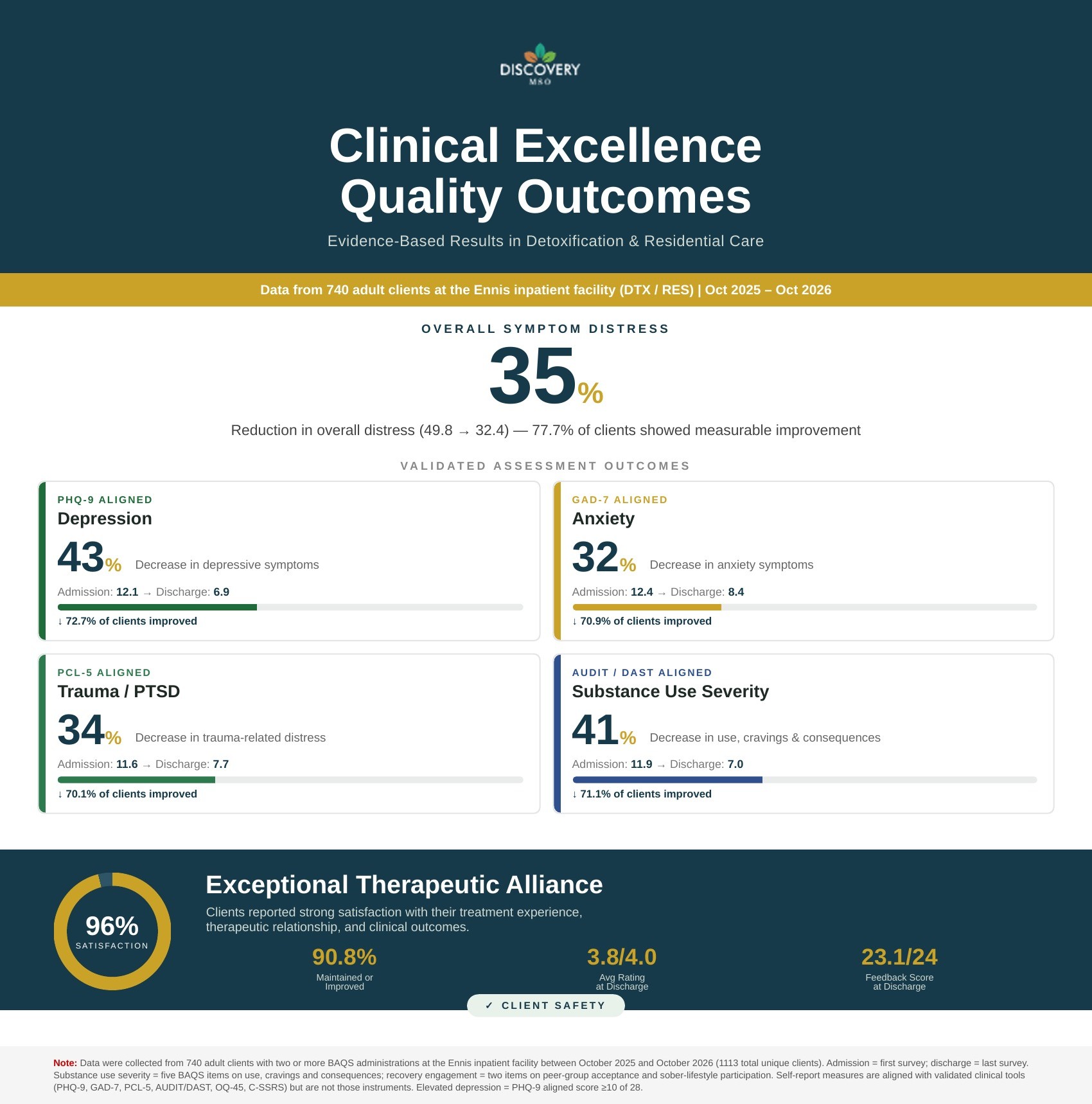
Our Ennis residential facility had 740 adults with paired surveys between October 2025 and October 2026. During their stay:
- Overall distress fell 35%, from an average of 49.8 to 32.4, and 77.7% of clients improved.
- Depressive symptoms fell 43%, and 72.7% of clients improved.
- Anxiety symptoms fell 32%, and 70.9% improved.
- Trauma-related distress fell 34%, and 70.1% improved.
- Substance use severity fell 41%, and 71.1% improved.
- Relationship functioning improved 24%.
Of the Ennis clients who arrived with clinically elevated depression, 60.0% scored below the clinical threshold by the end of their stay.
Waxahachie Results
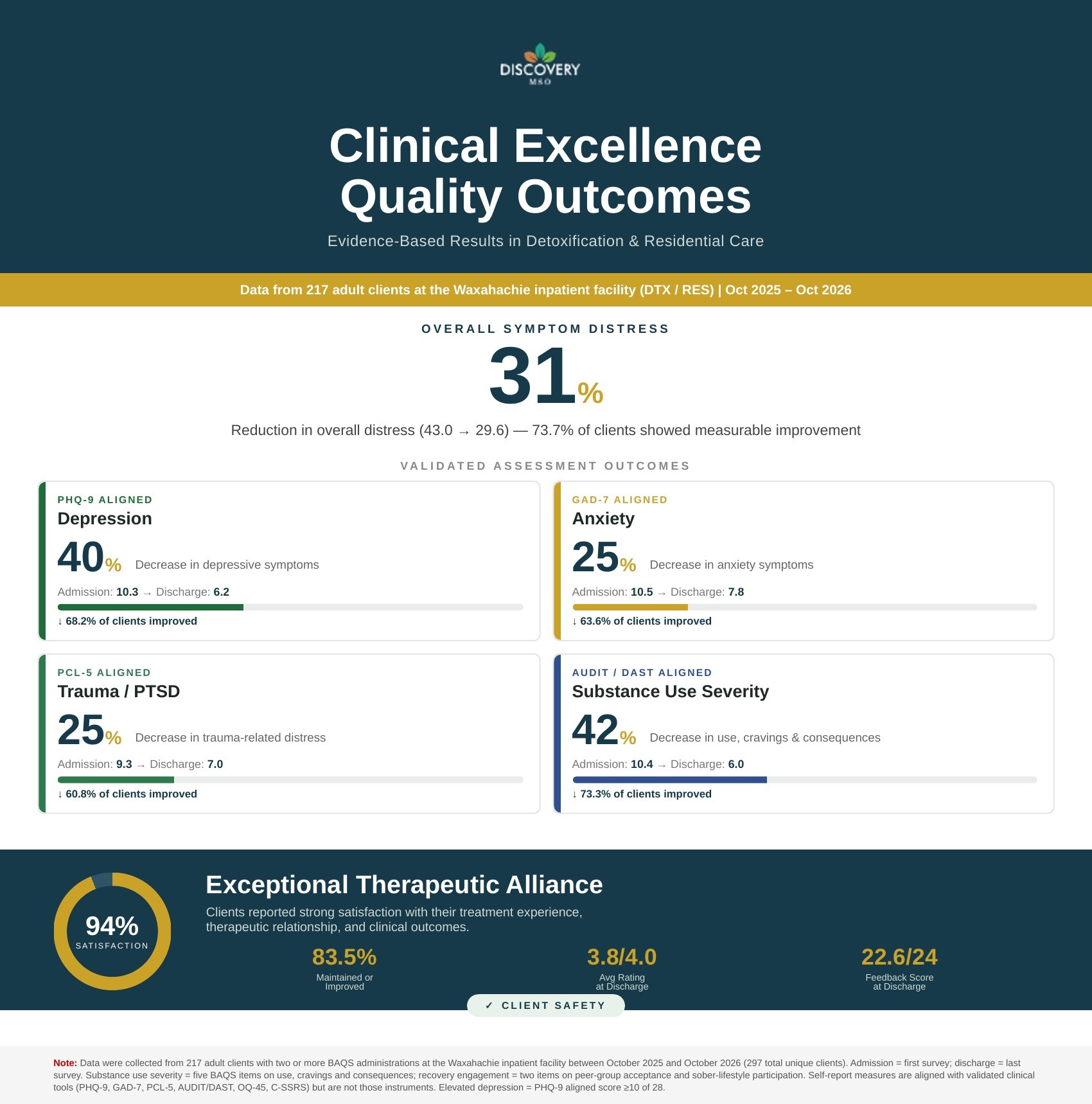
Our Waxahachie facility is DPR’s private-room residential program. It had 217 adults with paired surveys over the same period. During their stay:
- Overall distress fell 31%, from an average of 43.0 to 29.6, and 73.7% of clients improved.
- Depressive symptoms fell 40%, and 68.2% of clients improved.
- Anxiety symptoms fell 25%, and 63.6% improved.
- Trauma-related distress fell 25%, and 60.8% improved.
- Substance use severity fell 42%, and 73.3% improved.
- Relationship functioning improved 16%.
Of the Waxahachie clients who arrived with clinically elevated depression, 73.5% scored below the clinical threshold by the end of their stay.
Learn more about residential inpatient rehab at Waxahachie.
Reading the Numbers
A few things are worth keeping in mind.
People arrive in a hard place. Most clients start residential care in acute distress, so meaningful drops are expected when treatment is working. They are not automatic, though. The weekly survey is how the team checks that each person is actually moving in the right direction.
Each facility stands on its own. Ennis and Waxahachie serve different numbers of people and their clients start at different levels, so we report each one separately rather than blending them.
Four to five weeks is a start, not a finish. Residential care is where people stabilize. Many clients step down to outpatient care in Dallas afterward to keep building on that progress, and the clients who stay through both levels of care show the largest gains in our data.
This is self-report. The numbers show how clients describe their own symptoms. They are not sobriety or relapse rates, and individual results vary.
How Clients Rated Their Care
Each week, clients also rate their treatment experience and their relationship with their care team. Satisfaction was 96% at Ennis, where 90.8% of clients maintained or improved their rating through discharge, and 94% at Waxahachie, where 83.5% maintained or improved.
Feeling heard matters. A review of 295 studies covering more than 30,000 patients found a consistent positive link between the therapeutic alliance and treatment outcomes.
About this data: These results cover October 2025 through October 2026. Clients complete the same weekly self-report survey at every level of care. Its questions are aligned with widely used clinical screening tools, but it is DPR’s own instrument and not those tools themselves. The data was collected by Discovery Point Retreat, LLC, verified by Discovery MSO, LLC, and prepared for clinical review by Lauren Reisman, LMSW, and Dr. Jerry Vaccaro, M.D. The results reflect self-reported symptoms and day-to-day functioning. They are not sobriety or relapse rates, and individual results vary.
When to Reach Out for Help
It may be time to talk with someone if you or a person you care about is drinking or using more than planned, has tried to cut back and could not, feels strong cravings, needs more to get the same effect, or is running into problems at work, at home or with the law because of use. Feeling sick, shaky, anxious or unable to sleep when you stop is another sign that your body has adapted, and it is a good reason to get a medical opinion.
If you drink heavily or take sedatives such as benzodiazepines every day, do not stop suddenly without medical advice. Withdrawal from alcohol and sedatives can be dangerous, and a medically supervised detox is the safer way to stop.
If you or someone you know is in emotional crisis, call or text 988. If anyone is in immediate danger or cannot stay safe, call 911 or go to an emergency department.
If someone has stopped breathing, cannot be woken or may have overdosed, call 911, give naloxone if available, and stay with the person until help arrives.
Talking With a Professional
A good first call is mostly questions, and you are allowed to ask them. Ask how the program measures progress, how often it checks in with clients, and who reviews the results. Ask what happens when one level of care ends and the next one starts, and whether the same team and the same records follow you. Ask about cost and coverage up front. Our guide on how to verify your insurance benefits before rehab walks through the questions to ask your plan.
Our admissions team can talk through what you are dealing with, explain the difference between detox, residential and outpatient care, and help you figure out which level of care makes sense to start with. Ask which services are currently available at each location, since programs and schedules can change. You can reach the team online or by phone any time.
Frequently Asked Questions
How long is residential treatment at Discovery Point Retreat?
Residential treatment at Ennis and Waxahachie typically lasts four to five weeks, after detox when it is needed. The right length depends on each person, so the admissions team can talk through what fits your situation.
Does residential treatment address depression and anxiety?
Yes. DPR treats co-occurring mental health conditions as part of the plan, and tracks depression, anxiety and trauma-related symptoms every week during a residential stay.
What is the difference between Ennis and Waxahachie?
Both facilities run the same clinical model. Waxahachie is DPR’s private-room residential facility. Ask the admissions team which setting is the best fit and which services are currently available at each.
What happens after residential treatment?
Many clients step down to partial hospitalization or intensive outpatient care at DPR’s Dallas program, where the same weekly survey continues so the outpatient team can pick up where residential care left off.
Are these results guaranteed?
No. These are self-reported results from past clients over one year. They show general patterns, not a promise for any one person.
References
- Flückiger, C., et al. “The Alliance in Adult Psychotherapy: A Meta-Analytic Synthesis.” Psychotherapy, 2018. Accessed October 2026. pubmed.ncbi.nlm.nih.gov
Related Reading
- Residential inpatient treatment
- Residential rehab at our Ennis facility
- Residential rehab at our Waxahachie facility
- Co-occurring mental health conditions
- What to bring to rehab: a checklist
Resources
- 988 Lifeline: call or text 988, any time
- SAMHSA National Helpline: 1-800-662-HELP (4357), free, confidential, 24/7 treatment referral and information
- Emergencies: call 911
This article is general education and is not medical advice.
If you are ready to talk about treatment for yourself or someone you love, call Discovery Point Retreat at (855) 245-7133 or contact our admissions team online. We can walk you through detox, residential and outpatient options and help you take the next step.