Quick Summary: The relationship between a client and their care team is one of the most studied parts of therapy, and research consistently links a strong relationship to better results. At Discovery Point Retreat, clients rate that relationship every week, not just once at discharge. Between October 2025 and October 2026, satisfaction was 95% across the full continuum of care and 94% to 96% at each facility. Here is what we measure, why it matters and what it means for someone choosing a program.
Key Takeaways
- The “therapeutic alliance” is the working relationship between a client and their care team: trust, shared goals and agreement on the work.
- A review of 295 studies covering more than 30,000 patients found a consistent positive link between the alliance and treatment outcomes.
- DPR clients rate their care and their team every week on the same survey, from residential care through outpatient care.
- Satisfaction was 95% across the full continuum, 96% at Ennis, 94% at Waxahachie and 96% in Dallas.
- Most clients kept or raised their rating through discharge, at 90.8% in Ennis, 83.5% in Waxahachie, 90.2% in Dallas and 86.1% across the continuum.
What the Therapeutic Alliance Is
In plain terms, the therapeutic alliance is whether you and the people treating you are on the same team. It usually comes down to three things:
- Trust. Do you feel safe being honest with your therapist and care team?
- Shared goals. Do you agree on what you are working toward?
- The work itself. Do the sessions, groups and assignments feel like they are aimed at the right things?
When those pieces are in place, people tend to show up, open up and stick with the hard parts. When they are not, even a well-designed program can feel like it is happening to someone instead of with them.
What the Research Says
The alliance has been studied for decades across many kinds of therapy. A 2018 meta-analysis in the journal Psychotherapy pooled 295 independent studies covering more than 30,000 patients. The authors found a consistent positive relationship between the alliance and treatment outcome, and that relationship held across different therapy approaches, patient groups, measures and countries.
That is why we do not treat satisfaction as a nice extra. It is part of how treatment works.
How DPR Measures It
Every week, DPR clients answer a short set of questions about their treatment experience and their relationship with their care team, as part of the same self-report survey that tracks symptoms and substance use. They do it in residential treatment, and they keep doing it after stepping down to outpatient care in Dallas.
Measuring weekly matters. A one-time exit survey only tells you how someone felt on their last day. A weekly check-in shows how the relationship holds up through the hard weeks, too, and gives the team a chance to fix things while the client is still in care.
What Our Clients Told Us
Between October 2025 and October 2026:
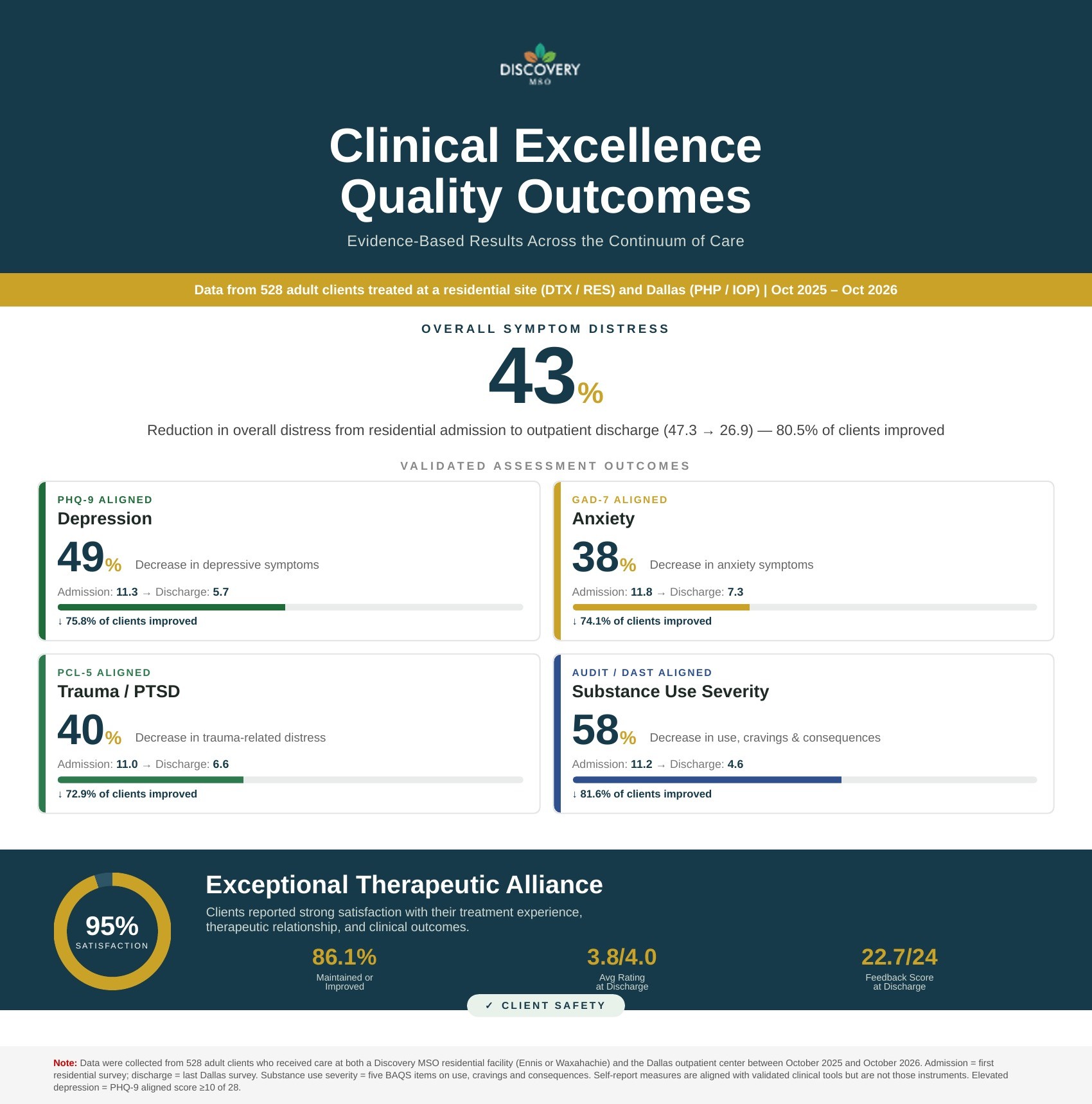
- Across the full continuum, among 528 adults who received residential care and then outpatient care, satisfaction was 95%, and 86.1% of clients maintained or improved their rating through discharge. That relationship held across two levels of care and two clinical teams.
- At Ennis, among 740 adults, satisfaction was 96%, and 90.8% maintained or improved their rating.
- At Waxahachie, among 217 adults, satisfaction was 94%, and 83.5% maintained or improved their rating.
- In Dallas, among 739 outpatient clients, satisfaction was 96%, and 90.2% maintained or improved their rating.
Why It Holds Up Through a Transition
Changing levels of care can strain a client’s trust. New building, new schedule, sometimes new faces. That is a point where people can feel like they are starting over.
Holding 95% satisfaction across the full continuum tells us the hand-off from residential care to outpatient care is working. Part of that is the shared survey: the outpatient team can see each client’s history and progress from day one, so clients do not have to retell their story or prove themselves again.
The Results That Go With It
High satisfaction would mean less if clients were not also getting better. Across the full continuum over the same year, overall distress fell 43%, depressive symptoms fell 49% and substance use severity fell 58%. We cannot say one number caused the other, but the research and our own data point the same direction: people do better in care they trust.
What to Look For in a Program
If you are comparing treatment programs, the relationship with your care team is worth asking about directly:
- How does the program check whether clients feel heard?
- How often does it ask, and what happens if a client is unhappy?
- Will the same records and team follow you from one level of care to the next?
Those questions are a fair way to gauge whether a program sees you as a partner in your own care.
About this data: These results cover October 2025 through October 2026. Clients complete the same weekly self-report survey at every level of care. Its questions are aligned with widely used clinical screening tools, but it is DPR’s own instrument and not those tools themselves. The data was collected by Discovery Point Retreat, LLC, verified by Discovery MSO, LLC, and prepared for clinical review by Lauren Reisman, LMSW, and Dr. Jerry Vaccaro, M.D. The results reflect self-reported symptoms and day-to-day functioning. They are not sobriety or relapse rates, and individual results vary.
When to Reach Out for Help
It may be time to talk with someone if you or a person you care about is drinking or using more than planned, has tried to cut back and could not, feels strong cravings, needs more to get the same effect, or is running into problems at work, at home or with the law because of use. Feeling sick, shaky, anxious or unable to sleep when you stop is another sign that your body has adapted, and it is a good reason to get a medical opinion.
If you drink heavily or take sedatives such as benzodiazepines every day, do not stop suddenly without medical advice. Withdrawal from alcohol and sedatives can be dangerous, and a medically supervised detox is the safer way to stop.
If you or someone you know is in emotional crisis, call or text 988. If anyone is in immediate danger or cannot stay safe, call 911 or go to an emergency department.
If someone has stopped breathing, cannot be woken or may have overdosed, call 911, give naloxone if available, and stay with the person until help arrives.
Talking With a Professional
A good first call is mostly questions, and you are allowed to ask them. Ask how the program measures progress, how often it checks in with clients, and who reviews the results. Ask what happens when one level of care ends and the next one starts, and whether the same team and the same records follow you. Ask about cost and coverage up front. Our guide on how to verify your insurance benefits before rehab walks through the questions to ask your plan.
Our admissions team can talk through what you are dealing with, explain the difference between detox, residential and outpatient care, and help you figure out which level of care makes sense to start with. Ask which services are currently available at each location, since programs and schedules can change. You can reach the team online or by phone any time.
Frequently Asked Questions
What is a therapeutic alliance?
It is the working relationship between a client and their care team, built on trust, shared goals and agreement about the work of treatment.
Why does the therapeutic alliance matter in addiction treatment?
Research pooling 295 studies and more than 30,000 patients found a consistent positive link between the alliance and treatment outcomes. People tend to engage more and stay with treatment when they trust the people helping them.
How does DPR measure client satisfaction?
Clients answer questions about their treatment experience and their relationship with their care team every week, as part of the same self-report survey used at every level of care.
What were DPR’s satisfaction results?
Between October 2025 and October 2026, satisfaction was 95% across the full continuum of care, 96% at Ennis, 94% at Waxahachie and 96% in Dallas.
What if I do not feel comfortable with my therapist?
Say so. A good program wants to know, and the weekly survey gives you a regular, low-pressure way to share how things are going with your care team.
References
- Flückiger, C., et al. “The Alliance in Adult Psychotherapy: A Meta-Analytic Synthesis.” Psychotherapy, 2018. Accessed October 2026. pubmed.ncbi.nlm.nih.gov
Related Reading
- Addiction treatment programs at Discovery Point Retreat
- Residential inpatient treatment
- Outpatient addiction treatment in Dallas
- What to expect in addiction recovery
Resources
- 988 Lifeline: call or text 988, any time
- SAMHSA National Helpline: 1-800-662-HELP (4357), free, confidential, 24/7 treatment referral and information
- Emergencies: call 911
This article is general education and is not medical advice.
If you are ready to talk about treatment for yourself or someone you love, call Discovery Point Retreat at (855) 245-7133 or contact our admissions team online. We can walk you through detox, residential and outpatient options and help you take the next step.