Quick Summary: New clinical outcomes data from Discovery Point Retreat’s Ennis and Waxahachie residential programs and Dallas outpatient program shows substantial, measurable improvement for clients treated between March and September 2026. Using the Brief Addiction Questionnaire Survey (BAQS), a clinical assessment administered at intervals throughout treatment, the data shows large reductions in depression, anxiety, and substance use severity in residential care, along with strong treatment feedback scores across every program.
Key Takeaways
- Substance use severity dropped by more than a third during residential treatment (38.7% at Ennis, 35.0% at Waxahachie).
- Depression symptoms improved by nearly 40% in residential care, with roughly seven in ten paired clients showing measurable relief.
- Treatment feedback scores (how supported and heard clients feel in their care) scored above 94% at every DPR facility.
- 255 clients appear in both the Ennis and Dallas datasets in this window, reflecting active use of DPR’s step-down pathway from residential to outpatient care.
Why We Track Outcomes
Addiction treatment works best when it’s measured, not just delivered. At Discovery Point Retreat, clients complete the BAQS, a 31-item clinical assessment modeled on the OQ-45.2 framework, at intervals throughout treatment. That gives our clinical team an ongoing, data-driven picture of what’s changing over the course of care, alongside the clinical judgment our team applies every day.
This refresh covers 671 clients at our Ennis residential facility, 182 at Waxahachie, and 600 at our Dallas outpatient program, with 905 clients across the three programs providing paired before-and-after survey data. The results were reviewed by Dr. Jerry Vaccaro, M.D., and Lauren Reisman, LMSW, and verified by Discovery MSO, LLC.
What the Data Shows
Substance Use Severity
Clients entering residential treatment at Ennis and Waxahachie typically arrive in acute crisis, often in active withdrawal or with severe co-occurring symptoms. Over the course of residential treatment, substance use severity scores fell by 38.7% at Ennis and 35.0% at Waxahachie, with roughly seven in ten paired clients at each facility showing improvement.
Clients in our Dallas outpatient (PHP/IOP) program, who typically enter at a much lower baseline severity, also showed a meaningful reduction in substance use severity (26.1%) over the course of their outpatient episode, one of the clearest positive results in the Dallas program.
Depression and Anxiety
Depression scores fell by 39.9% at Ennis and 37.1% at Waxahachie in residential care, with roughly seven in ten paired clients at each facility showing improvement. Anxiety scores dropped by 29.8% at Ennis. Our clinical team attributes these results to the combination of medical stabilization during detox and structured therapeutic programming, including CBT and DBT-based groups, during the residential stay.
Treatment Feedback
Treatment feedback, how supported, heard, and engaged a client feels in their care, is a measure our clinical team watches closely throughout every episode of treatment. Across Discovery Point Retreat’s programs, feedback scores were exceptionally strong: 96.1% at Ennis, 95.7% in our Dallas outpatient program, and 94.4% at Waxahachie, up from 89.9% in our June 2026 report.
The Continuum of Care in Action
Discovery Point Retreat is built around a phased continuum: detoxification, residential treatment, and structured outpatient step-down care. In this reporting window, 255 clients appear in both the Ennis and Dallas datasets, and a similar overlap exists between Waxahachie and Dallas, evidence that clients are actively using DPR’s full continuum rather than a single, isolated level of care. Recovery is a process, and our program structure is designed to support clients through every phase of it.
Full Results by Program
These figures show the change in average score between each client’s first and last survey during March to September 2026. Lower scores are better. Paired clients have at least two valid surveys, and 905 clients across the three programs have paired data.
Ennis Residential
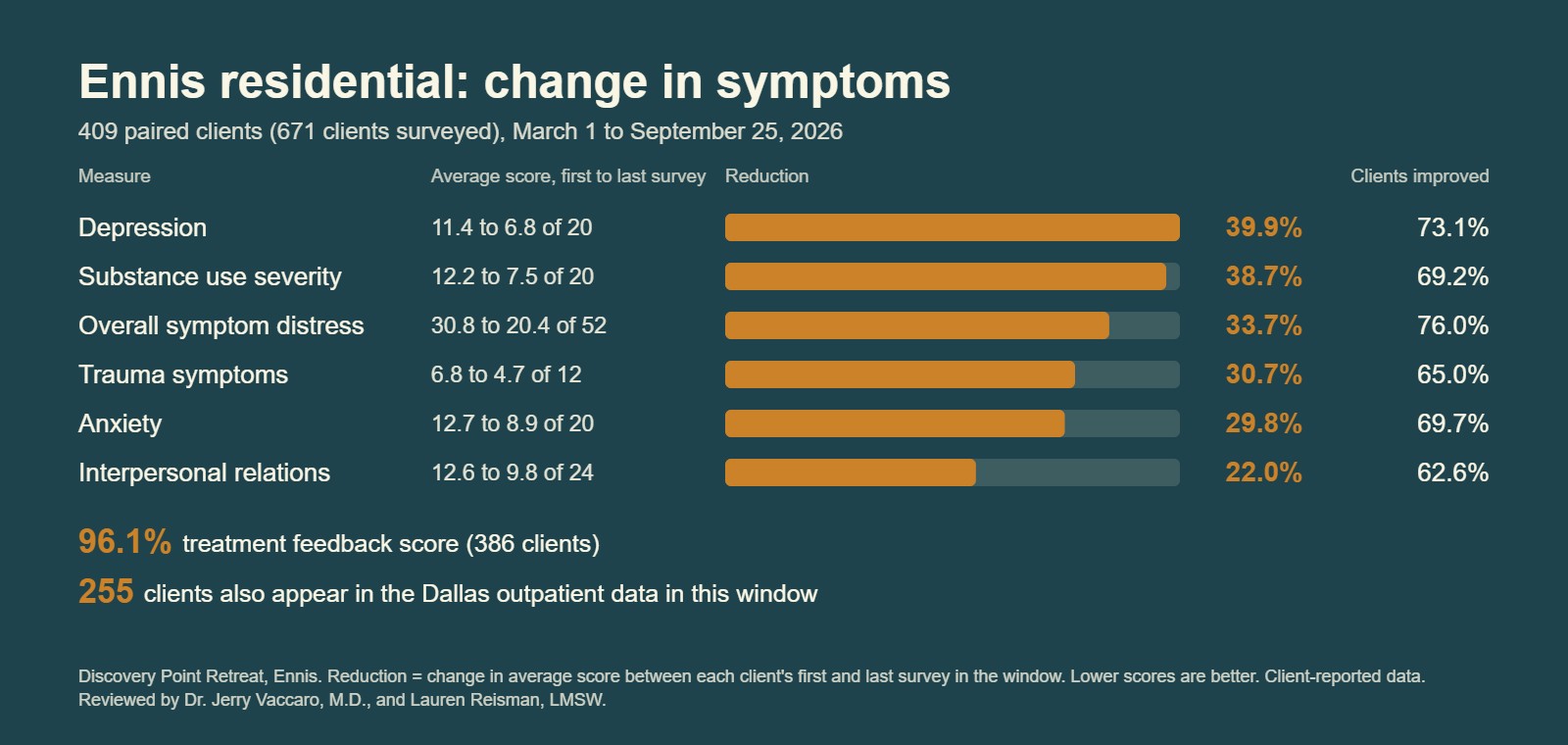
671 clients were surveyed and 409 had paired surveys (March 1 to September 25).
| Measure | First to last survey | Reduction | Clients improved | Clients worsened |
|---|---|---|---|---|
| Depression | 11.4 to 6.8 of 20 | 39.9% | 73.1% | 13.4% |
| Substance use severity | 12.2 to 7.5 of 20 | 38.7% | 69.2% | 13.4% |
| Overall symptom distress | 30.8 to 20.4 of 52 | 33.7% | 76.0% | 13.9% |
| Trauma symptoms | 6.8 to 4.7 of 12 | 30.7% | 65.0% | 16.9% |
| Anxiety | 12.7 to 8.9 of 20 | 29.8% | 69.7% | 15.9% |
| Interpersonal relations | 12.6 to 9.8 of 24 | 22.0% | 62.6% | 17.4% |
The treatment feedback score was 96.1%. 255 Ennis clients also appear in the Dallas outpatient data in this window.
Waxahachie Residential
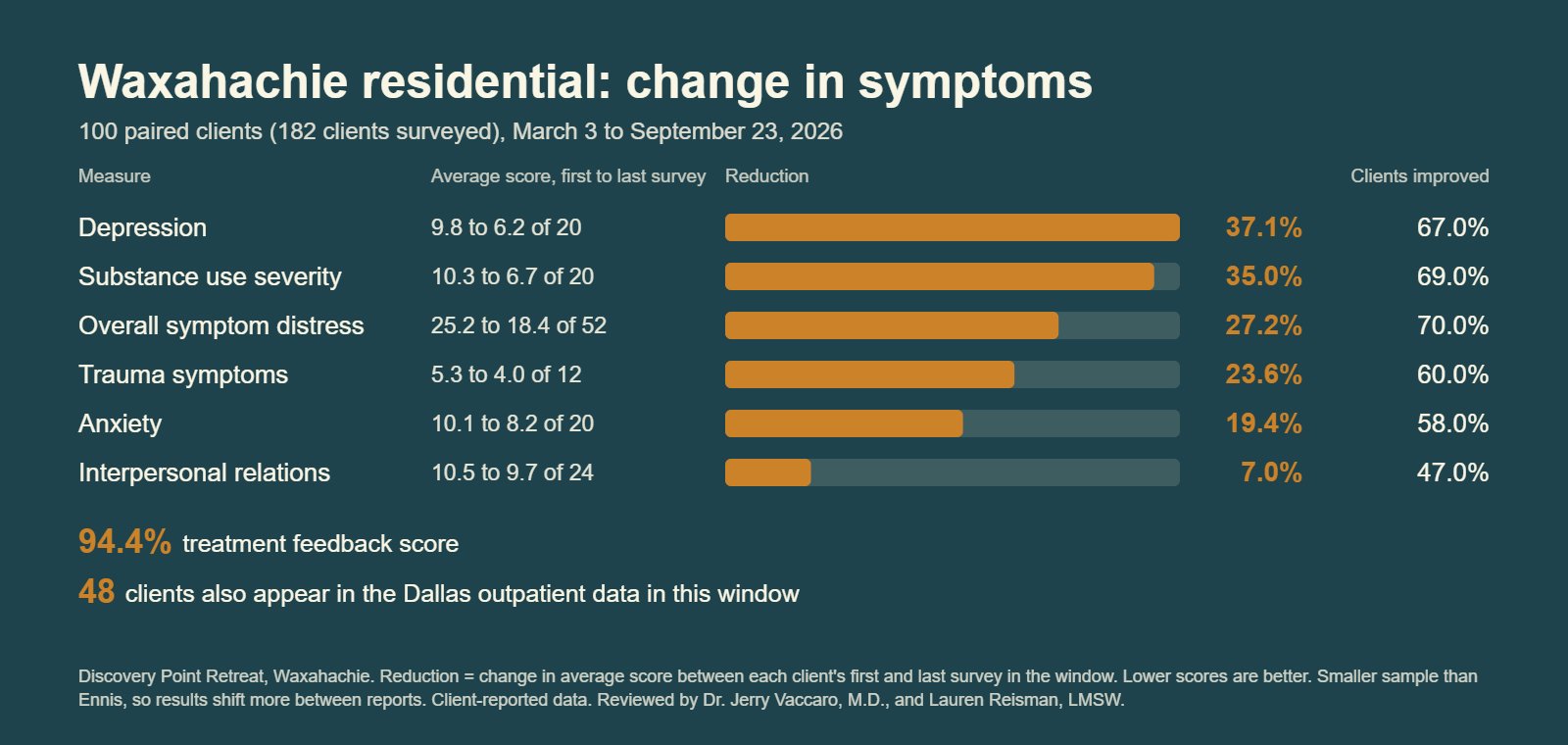
182 clients were surveyed and 100 had paired surveys (March 3 to September 23). This is a smaller sample than Ennis, so results shift more between reports.
| Measure | First to last survey | Reduction | Clients improved | Clients worsened |
|---|---|---|---|---|
| Depression | 9.8 to 6.2 of 20 | 37.1% | 67.0% | 16.0% |
| Substance use severity | 10.3 to 6.7 of 20 | 35.0% | 69.0% | 20.0% |
| Overall symptom distress | 25.2 to 18.4 of 52 | 27.2% | 70.0% | 18.0% |
| Trauma symptoms | 5.3 to 4.0 of 12 | 23.6% | 60.0% | 18.0% |
| Anxiety | 10.1 to 8.2 of 20 | 19.4% | 58.0% | 21.0% |
| Interpersonal relations | 10.5 to 9.7 of 24 | 7.0% | 47.0% | 29.0% |
The treatment feedback score was 94.4%. 48 Waxahachie clients also appear in the Dallas outpatient data.
Dallas Outpatient (PHP/IOP)
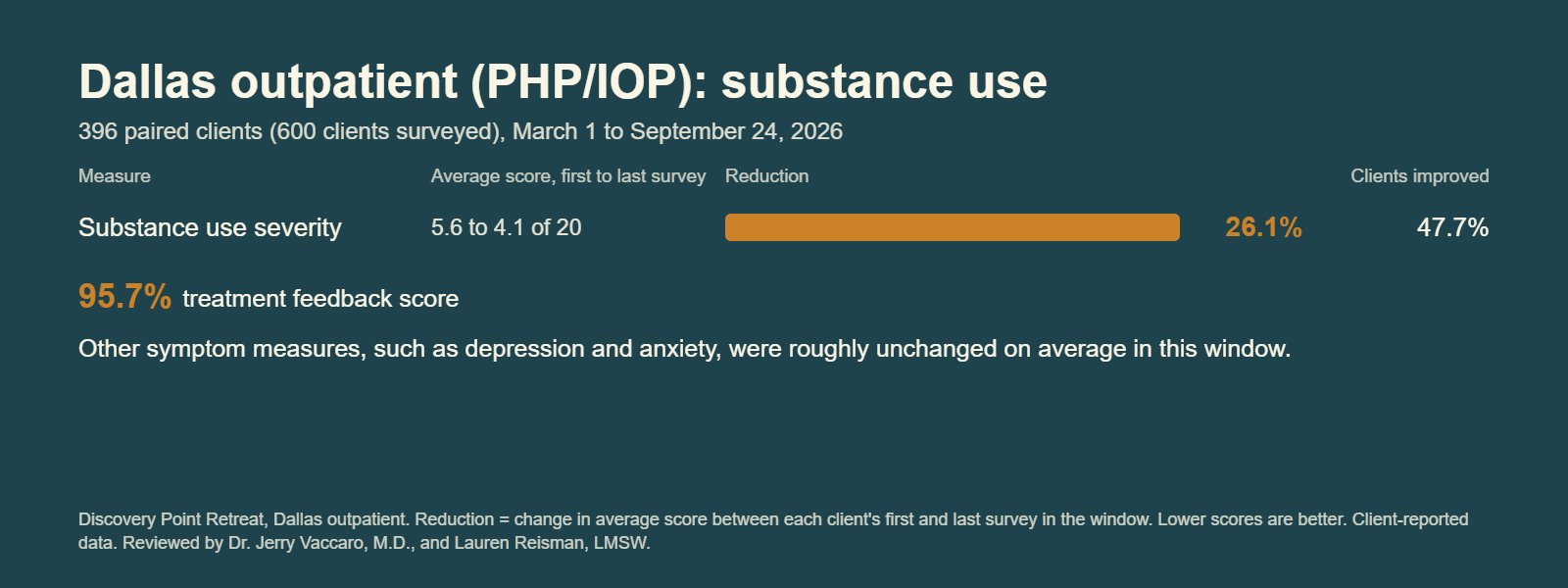
600 clients were surveyed and 396 had paired surveys (March 1 to September 24).
| Measure | First to last survey | Reduction | Clients improved | Clients worsened |
|---|---|---|---|---|
| Substance use severity | 5.6 to 4.1 of 20 | 26.1% | 47.7% | 29.8% |
The treatment feedback score was 95.7%. Other symptom measures, such as depression and anxiety, were roughly unchanged on average in this window.
When to Reach Out for Help
If you or someone you love is struggling with substance use, waiting for “rock bottom” isn’t necessary. If you’re noticing warning signs like withdrawal from relationships, missed work or school obligations, mood changes, or an inability to cut back despite wanting to, it’s worth reaching out for a confidential conversation about treatment options.
Talking With a Professional
Every DPR client begins with a clinical assessment that helps our team understand their specific history, co-occurring conditions, and the right level of care to start at, whether that’s medically supervised detox, residential treatment, or outpatient support. This conversation is confidential, and you don’t have to have it all figured out before you call. Our team is available to walk you through options, insurance verification, and next steps.
Related Reading
- Addiction Treatment Programs
- Ennis Residential Treatment Program
- Dallas Outpatient / PHP-IOP Program
- Waxahachie Residential Treatment
- Co-Occurring Mental Health & Substance Use Disorders
References
- Substance Abuse and Mental Health Services Administration (SAMHSA). “Behavioral Health Treatments and Services.” Accessed October 2026. https://www.samhsa.gov/find-help/treatment
- National Institute on Drug Abuse (NIDA). “Treatment Approaches for Drug Addiction.” Accessed October 2026. https://nida.nih.gov/publications/drugfacts/treatment-approaches-drug-addiction
- Centers for Disease Control and Prevention (CDC). “Treatment of Substance Use Disorders.” Accessed October 2026. https://www.cdc.gov/overdose-prevention/treatment/index.html
Source for the outcomes data: Discovery Point Retreat client survey data, March to September 2026, reviewed by Dr. Jerry Vaccaro, M.D., and Lauren Reisman, LMSW.
FAQ
What is the BAQS assessment DPR uses to track outcomes? The Brief Addiction Questionnaire Survey (BAQS) is a 31-item clinical assessment administered at intervals throughout treatment to track changes in symptom distress, interpersonal functioning, and treatment engagement over time.
Does starting treatment at the residential level guarantee a spot in outpatient step-down care? Step-down planning is individualized and begins early in a client’s residential stay, coordinated between the clinical team and our Dallas outpatient program to support a smooth transition when it’s clinically appropriate.
How is client data kept confidential? All outcomes reporting is conducted in aggregate and reviewed under HIPAA-compliant clinical protocols. No individual client information is shared publicly.
Is Discovery Point Retreat’s data independently reviewed? Yes. Findings are reviewed by DPR’s clinical leadership, including a licensed physician and licensed clinical social worker, and verified by Discovery MSO, LLC.
Resources
- SAMHSA National Helpline: 1-800-662-4357
- In an emergency, call 911
This article is general education and is not medical advice.
If you or someone you love is ready to talk about treatment options, Discovery Point Retreat’s team is available to help. Call (855) 635-4776 to speak with someone confidentially today.