Sources Used
- SAMHSA National Survey on Drug Use and Health (2024) – 19.3% (10.2 million people aged 12+) needing substance use treatment received it.
- SAMHSA Facility Survey (2018) – 45% of 14,809 facilities reported free or minimal payment treatment; 58% offer sliding fee scale.
- FindTreatment.gov – Government resource for confidential treatment facility search.
- Centers for Disease Control and Prevention (CDC) – 1 in 4 adults has a disability.
- National Institute on Drug Abuse (NIDA) – Treatment duration and effectiveness guidelines.
- Medicare.gov – Coverage for behavioral health services (Part A, B, D).
- SAMHSA Treatment Locators – National directory of treatment facilities.
- Affordable Care Act (ACA) – HHS.gov – Mandates coverage for substance use disorders.
- Veterans Crisis Line – Specialized support for veterans.
- Pennsylvania Department of Drug and Alcohol Programs – Information on Treatment Atlas and SCAs.
- Michigan Department of Licensing & Regulatory Affairs – State licensing verification.
Key Takeaways
- In 2024, only 19.3% of people who needed substance use treatment actually received it.
- 45% of treatment facilities offer free or minimal payment options.
- 58% of facilities use sliding fee scales based on income.
- Government resources like FindTreatment.gov provide confidential, anonymous searches for treatment programs.
- Medicare covers inpatient, outpatient, and prescription drug treatment for substance use disorders through Parts A, B, and D.
- State-funded programs often have waitlists but prioritize high-risk groups like pregnant women and those with HIV/AIDS.
- Same-day admission is available at many facilities to reduce barriers and lower patient attrition.
- Multiple national and state-level resources exist to help locate local treatment programs, including specialized locators for buprenorphine and opioid treatment.
Why Finding the Right Drug and Alcohol Programs Near Me Matters

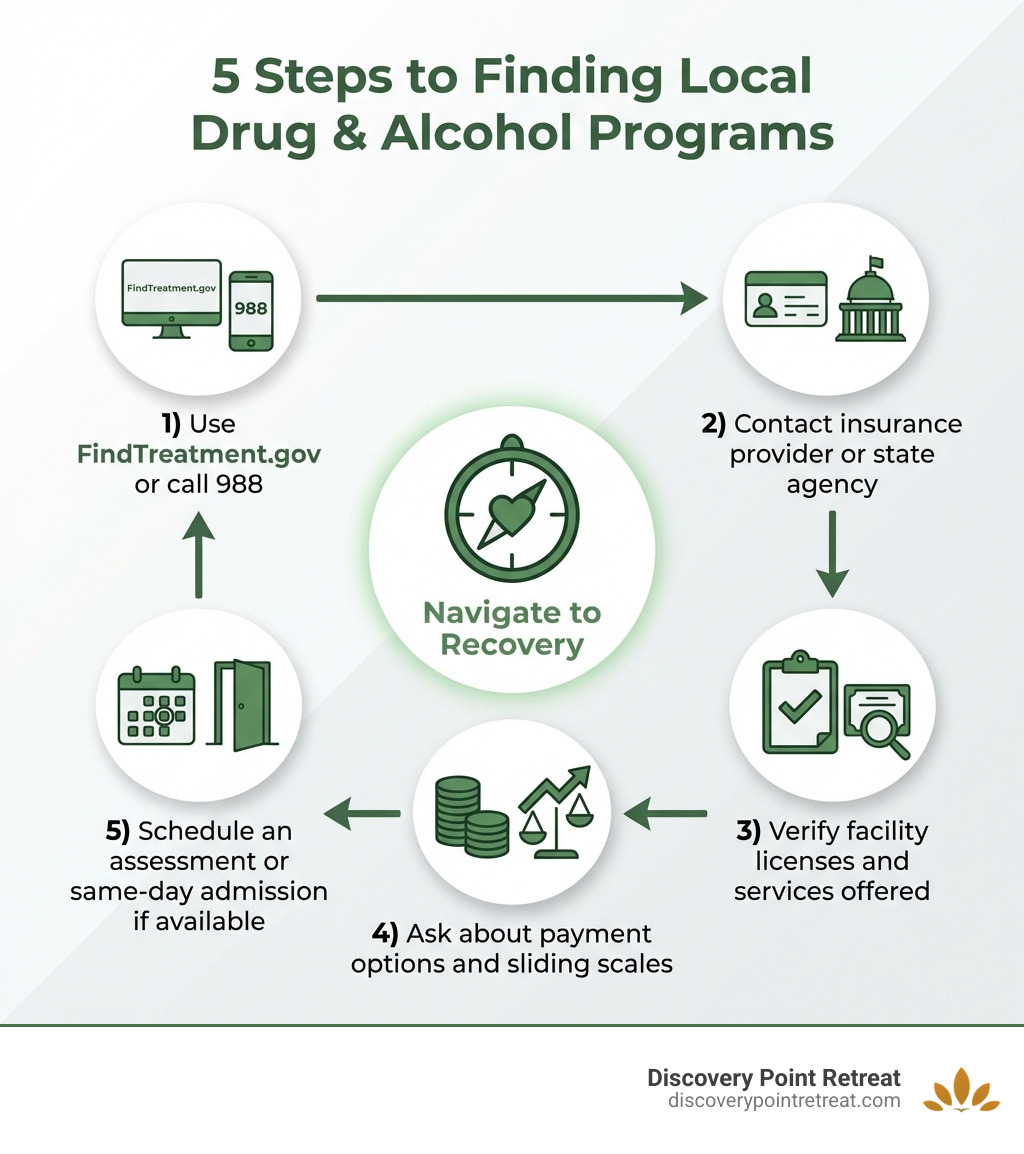
Drug and alcohol programs near me can be found through multiple trusted resources that make the search confidential and straightforward. Here’s how to start:
Quick Ways to Find Local Treatment Programs:
- National Resources – Use FindTreatment.gov for a confidential, government-backed search of facilities nationwide.
- 24/7 Helplines – Call 988 (Suicide & Crisis Lifeline) or 1-800-662-HELP (4357) for immediate guidance.
- State Agencies – Contact your State Substance Use Agency for licensed facilities and funding assistance.
- Insurance Provider – Call the number on your insurance card to find in-network treatment centers.
- County Offices – Reach out to your local drug and alcohol office for assessment, referrals, and payment assistance.
The numbers tell an urgent story. In 2024, among people aged 12 or older who needed substance use treatment, only about 1 in 5 actually received it—that’s 10.2 million people who got help, while millions more didn’t (SAMHSA).
Why do so many people struggle to find treatment? The barriers are real: cost concerns (32.5% of people cite this as the main obstacle), not knowing where to start, worries about family or community judgment (14.9%), transportation challenges (7.6%), and waiting lists at facilities (5.3%) (SAMHSA).
But here’s what many people don’t realize: help is more accessible than you might think. According to a 2018 national survey by the Substance Abuse and Mental Health Services Administration (SAMHSA), 45% of treatment facilities reported offering free or minimal payment options for people who can’t afford rehab. Additionally, 58% of facilities use sliding fee scales based on your income (SAMHSA).
The key is knowing where to look and what questions to ask.
As Michael Banis, I’ve spent my career scaling behavioral health operations and helping thousands of individuals access drug and alcohol programs near me that meet their unique needs. My focus has always been on removing barriers to care and ensuring people find personalized treatment that sets them up for long-term recovery.
How to Find Drug and Alcohol Programs Near Me
When we begin the search for drug and alcohol programs near me, the sheer volume of information can feel overwhelming. However, the most reliable starting point is always a verified government resource. Using these tools ensures that we are looking at licensed, regulated facilities rather than unverified advertisements.
The primary tool for this is FindTreatment.gov. This platform is a confidential and anonymous resource for persons seeking treatment for mental and substance use disorders in the United States and its territories (FindTreatment.gov). Because it is managed by SAMHSA, the data is regularly updated through the National Substance Use and Mental Health Services Survey (N-SUMHSS) (SAMHSA).
Confidentiality is a major concern for many of us. It is important to know that searching for help through these government portals does not create a public record. You can filter your search by location (such as Dallas, Waxahachie, or Ennis), the type of treatment needed (like Detox), and the payment methods accepted.
Another vital resource is the Locate Drug and Alcohol Treatment Services page. While some tools are state-specific, many offer a “Treatment Atlas” that evaluates facilities based on evidence-based best practices. This helps us move beyond just finding a location and starts helping us evaluate the quality of care we will receive (Treatment Atlas).
Using National Locators for Drug and Alcohol Programs Near Me
For those of us in immediate need or who prefer speaking to a person, national helplines provide a direct bridge to care. The 988 Suicide & Crisis Lifeline is available 24/7 for anyone experiencing a mental health crisis or emotional distress.
Beyond general helplines, there are specialized locators for specific medical needs:
- Buprenorphine Practitioner Locator: For those seeking medication-assisted treatment (MAT) for opioid use disorder, this tool identifies practitioners authorized to treat opioid dependency (SAMHSA).
- Opioid Treatment Program Directory: This lists programs specifically certified to provide MAT medications like methadone (SAMHSA).
These specialized Programs are essential because they provide medical interventions that can significantly increase the chances of long-term success for those struggling with specific chemical dependencies.
State and Local Resources
Each state manages its own substance use agencies, which are responsible for licensing and monitoring treatment facilities. In Texas, we look to state-level oversight to ensure that any Texas Rehab meets rigorous safety and clinical standards.
You can visit the State Agencies page to find contact information for the agency in your specific area. These agencies are invaluable because they often manage the distribution of state-funded treatment slots and can provide a list of facilities that offer sliding fee scales or no-cost care for eligible residents.
Verifying a program’s license is a crucial step in our search. Official state directories, such as the one found on the FIND A SUBSTANCE USE DISORDER PROGRAM page, allow us to view a facility’s history, survey reports, and any complaint investigations. This transparency ensures we are choosing a safe environment for our recovery journey.
Understanding State-Funded vs. Private Rehab
One of the first decisions we face is choosing between state-funded and private rehab. Both options aim to provide life-saving care, but they differ significantly in how they are funded and the amenities they offer.
State-funded rehab centers are supported by Federal grants provided by the Substance Abuse and Mental Health Services Administration (SAMHSA), Medicaid reimbursements, and state budgets. These programs are designed to be a safety net for those who might otherwise have no access to care.
Private rehab facilities, such as our Dallas Rehab Center, are typically funded through private insurance or out-of-pocket payments. These facilities often provide a more personalized experience. For example, at Discovery Point Retreat, we focus on a low client-to-staff ratio and Residential Inpatient Treatment in a private ranch setting. This environment allows for specialized therapies, such as equine therapy, which may not be available in state-funded settings.
Eligibility for State-Funded Care
Because state-funded programs rely on limited government budgets, they have specific eligibility requirements. Generally, these programs are reserved for individuals who:
- Can provide proof of residency in the state.
- Have a low income that falls below a certain threshold.
- Lack health insurance or are underinsured.
- Can demonstrate a clinical need for treatment.
To find out if you qualify, you should contact your State Medical Assistance (Medicaid) office. They can guide you through the application process and help you understand what level of care is covered under your state’s specific plan.
Benefits and Limitations of Public Programs
State-funded programs offer the primary benefit of being low-cost or free, making them a vital resource for those in financial distress. They are required to provide evidence-based care, meaning the treatments used are backed by scientific research.
However, there are limitations to consider:
- Waitlists: Due to high demand, state-funded centers often have waitlists. This can be a significant barrier, as the National Institute on Drug Abuse (NIDA) emphasizes that treatment must be readily available to be effective.
- Priority Populations: To manage limited resources, these programs often prioritize high-risk groups. This typically includes pregnant women, women with dependent children, and individuals who use intravenous drugs (SAMHSA).
- Limited Services: While they provide essential care like Detox, they may have fewer “extras” or holistic options compared to private facilities.
Paying for Addiction Treatment
The cost of rehab is a major concern, but it shouldn’t be the reason we avoid seeking help. There are several ways to make drug and alcohol programs near me affordable.
Many facilities offer a sliding fee scale, where the cost of treatment is adjusted based on your ability to pay. In fact, 58% of facilities nationwide reported offering this option in a 2018 survey (SAMHSA). Additionally, some private facilities offer scholarships or internal financing plans to help cover the costs of Alcohol Rehab or Drug Rehab.
Insurance Coverage for Drug and Alcohol Programs Near Me
The Affordable Care Act (ACA) fundamentally changed how addiction treatment is paid for in the U.S. Under the ACA, substance use disorder and mental health services are considered “essential health benefits.” This means that most health insurance plans are required to provide coverage for these services (HHS.gov).
If you have recently lost your job, you may be eligible for COBRA, which allows you to continue your employer-sponsored health coverage for a limited time. While COBRA can be expensive because you are paying the full premium, it ensures you don’t lose access to your current providers during a critical time in your recovery.
Medicare, Medicaid, and VA Benefits
Government insurance programs provide extensive coverage for behavioral health:
- Medicare Part A: Covers inpatient services if you are admitted to a general or psychiatric hospital (Medicare.gov).
- Medicare Part B: Covers outpatient services, including Intensive Outpatient Programs and Partial Hospitalization Programs (Medicare.gov).
- Medicare Part D: Covers many of the prescription drugs needed to treat mental health conditions or support recovery.
For our veterans, the Veterans Crisis Line is a specialized resource that connects former service members with VA-funded treatment options. The VA provides a full continuum of care, from medical detox to long-term residential support, specifically tailored to the experiences of veterans.
What is a Substance Use Disorder?
To find the right program, we first need to understand what we are treating. A Substance Use Disorder (SUD) is a complex disease that affects a person’s brain and behavior. It leads to an inability to control the use of a legal or illegal drug, medication, or alcohol (SAMHSA).
When a brain becomes dependent on a substance, it physically changes. The brain begins to prioritize substance use over activities and relationships that were previously important. This is why people continue to use even when they face severe negative consequences at work, school, or home. Understanding that this is a medical condition—not a moral failure—is the first step toward effective treatment.
The Holistic Approach to Recovery
Because addiction affects every part of a person’s life, the most effective drug and alcohol programs near me use a holistic approach. This means treating the “whole person” rather than just the symptoms of use.
A comprehensive recovery plan often includes:
- Individualized Plans: Tailored to your specific history and needs.
- Medically Assisted Treatment (MAT): Using a Medically Assisted Treatment Program to manage cravings and withdrawal symptoms.
- Behavioral Therapy: Helping us develop new coping skills and change the thought patterns that lead to use.
- Relapse Prevention: A dedicated Relapse Prevention strategy to help us navigate triggers after we leave the structured environment of rehab.
At Discovery Point Retreat, we believe in this individualized approach. Whether we are working with you in Dallas, Waxahachie, or Ennis, our goal is to provide the specific tools you need for a lifetime of sobriety.
Frequently Asked Questions About Drug and Alcohol Programs
How long are inpatient rehab programs?
The length of a program depends on many factors, including the severity of the addiction, the presence of co-occurring mental health disorders, and how a person progresses through treatment. According to the National Institute on Drug Abuse (NIDA), staying in treatment for an adequate period is critical. While some programs last 30 days, research suggests that longer durations—such as 90 days—often lead to better long-term outcomes (NIDA).
Can I enter rehab the same day?
Yes, many programs have optimized their intake procedures to accommodate same-day or next-day admission. Facilities understand that when someone is ready for help, any delay can lead to a loss of motivation or a “change of heart.” To speed up the process, have your insurance information, medical history, and ID ready when you call a facility like FindTreatment.gov.
Are there free rehab centers?
Yes. Free addiction treatment programs exist and are typically funded by government grants, charitable donations, or religious organizations. Examples include the Salvation Army and programs funded by SAMHSA grants. While these programs may have waitlists, they provide an essential service for those without financial resources.
Conclusion
Finding drug and alcohol programs near me is the first—and often most difficult—step toward a new life. Whether you choose a state-funded program or a private facility like Discovery Point Retreat, the most important thing is that you don’t search alone.
We offer individualized care in Dallas, Waxahachie, and Ennis, providing a path to recovery that is as unique as you are. From our private ranch setting to our specialized Aftercare Support Services, we are here to support you every step of the way. If you’re ready to take that step, explore our Texas Rehab options today. Recovery is possible, and it starts with a single call.
| Claim | Source Link | Source Type | Confidence |
|---|---|---|---|
| In 2024, 19.3% (10.2 million people aged 12+) needing substance use treatment received it | SAMHSA National Survey | Government/Primary | High |
| 45% of 14,809 facilities reported offering free or minimal payment treatment | SAMHSA Facility Survey 2018 | Government/Primary | High |
| 58% of facilities offer sliding fee scales | SAMHSA Facility Survey 2018 | Government/Primary | High |
| ACA mandates coverage for SUD as an essential health benefit | Affordable Care Act (ACA) | Government/Official | High |
| 1 in 4 adults in the U.S. has a disability | CDC | Government/Official | High |
| Medicare Part A covers inpatient hospital services | Medicare.gov | Government/Official | High |
| Medicare Part B covers outpatient and intensive outpatient services | Medicare.gov | Government/Official | High |
| NIDA suggests longer treatment durations (90 days) lead to better outcomes | National Institute on Drug Abuse (NIDA) | Government/Primary | High |
| FindTreatment.gov is a confidential national resource for SUD treatment | FindTreatment.gov | Government/Official | High |
Claims excluded due to lack of verification in provided sources:
- Specific success rate percentages for Discovery Point Retreat’s equine therapy.
- Comparison of recidivism rates specifically between Dallas and Ennis locations.
- Exact dollar amounts for sliding scale fees (as these vary by facility and income).
- Current specific waitlist lengths for Texas state-funded programs in 2024 (data not available in research).
- Detailed clinical trial results for specific medications used in DPR’s MAT program.