A) Evidence Inventory
Sources Used:
- Kelly, J. F., Humphreys, K., & Ferri, M. (2020). “Alcoholics Anonymous and other 12-step programs for alcohol use disorder.” Cochrane Database of Systematic Reviews. Link
- Alcoholics Anonymous World Services, Inc. “The Twelve Steps of Alcoholics Anonymous.” Link
- Bøg, M., et al. (2017). “12-step programs for reducing illicit drug use.” Campbell Systematic Reviews. Link
- Hazelden Betty Ford Foundation. “What Are the 12 Steps of AA?” Link
- SAMHSA (2023). “National Survey of Substance Use.” (Cited in AAC research). Link
- Al-Anon Family Groups. “Al‑Anon’s Twelve Steps.” Link
- Bill W. (2001). “Alcoholics Anonymous” (4th ed.). Link
- Narcotics Anonymous (1987). “Chapter 8: We Do Recover.” Link
Key Takeaways:
- Superiority in Alcohol Recovery: A landmark 2020 Cochrane review established that AA and 12-step facilitation are more effective than Cognitive Behavioral Therapy (CBT) and Motivational Enhancement Therapy (MET) for achieving long-term, sustained alcohol abstinence.
- Diverse Applications: While born from alcoholism recovery, only about 20% of 12-step programs focus on substance use; the remaining 80% address issues like debt, overeating, and depression.
- Spiritual vs. Religious: The “Higher Power” concept is intentionally flexible, allowing members to choose their own interpretation, including secular or community-based versions.
- Governance through Traditions: The 12 Traditions ensure group unity by mandating anonymity, financial self-sufficiency, and a non-professional, non-hierarchical structure.
- Illicit Drug Outcomes: For illicit drugs, 12-step programs perform roughly as well as other clinical interventions, according to a 2017 systematic review.
- Sponsorship: This peer-to-peer mentoring is a unique cornerstone of the program, providing accountability and experience-sharing without the power dynamics of clinical therapy.
Understanding the 12 Steps Anonymous Framework

12 steps anonymous programs represent a structured approach to recovery that has helped millions of people worldwide overcome addiction and other compulsive behaviors. These mutual aid fellowships follow a set of spiritual principles designed to guide individuals through personal transformation and lasting change.
What Are the 12 Steps Anonymous Programs?
The 12 steps anonymous programs include:
- Admitting powerlessness over the addiction and acknowledging life has become unmanageable
- Believing in a Higher Power (interpreted personally) that can restore sanity
- Turning over will and life to this Higher Power’s care
- Conducting a moral inventory through fearless self-examination
- Admitting wrongs to oneself, another person, and a Higher Power
- Becoming ready for removal of character defects
- Humbly asking for shortcomings to be removed
- Making a list of all people harmed
- Making direct amends wherever possible
- Continuing personal inventory and promptly admitting wrongs
- Seeking conscious contact with a Higher Power through prayer and meditation
- Carrying the message to others and practicing these principles in all areas of life
These programs originated with Alcoholics Anonymous in 1935 but have since expanded to address everything from narcotics addiction to gambling, overeating, and codependency. Research shows significant effectiveness—a 2020 Cochrane review found that AA participation resulted in more sustained abstinence than Cognitive Behavioral Therapy or Motivational Enhancement Therapy for alcohol use disorder.
As Michael Banis, I’ve spent years leading addiction treatment operations and have seen how 12 steps anonymous programs serve as a foundational element in comprehensive recovery strategies. My experience scaling behavioral health services has shown me that while 12-step fellowships provide crucial peer support, they work best when integrated with personalized, evidence-based treatment approaches.
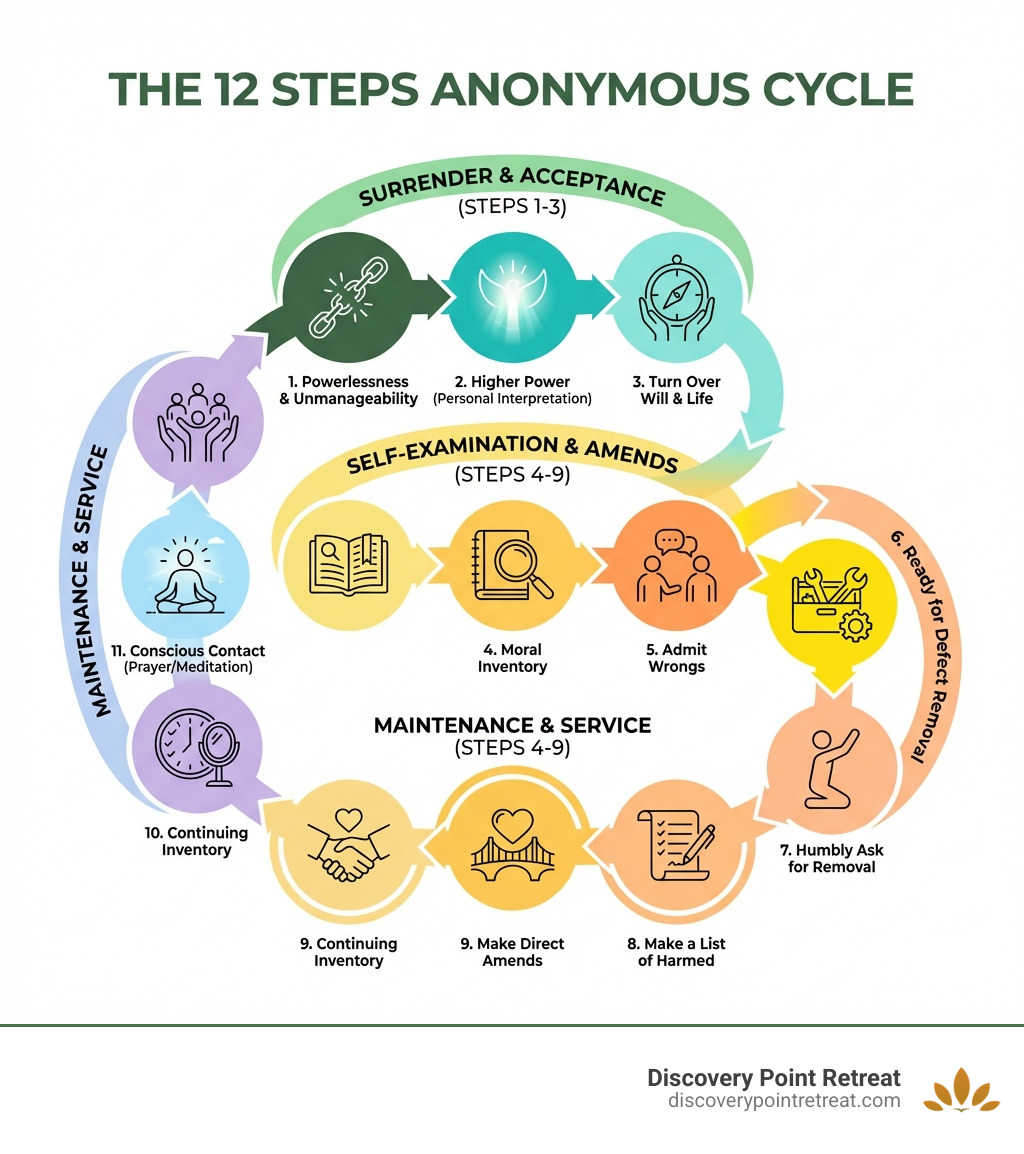
This infographic illustrates the continuous cycle of the 12 steps, showing how steps 1-3 focus on surrender and acceptance, steps 4-9 involve self-examination and making amends, and steps 10-12 emphasize ongoing maintenance and service to others in recovery.
The History and Origin of 12-Step Fellowships
The story of 12 steps anonymous begins in 1935 in Akron, Ohio. It was here that Bill Wilson (Bill W.), a New York stockbroker, and Dr. Bob Smith (Dr. Bob), an Akron surgeon, discovered a truth: when one alcoholic shares their experience with another, the compulsion to drink can be lifted. Both men had been influenced by the Oxford Group, a Christian organization that emphasized rigorous honesty and making amends White & Kurtz, 2008.
In 1939, the fellowship published its primary text, Alcoholics Anonymous, often called the “Big Book.” This book formalized the 12 steps we know today. Bill W. famously added the phrase “as we understood Him” to the steps to ensure that the program remained accessible to people of all faiths—or no faith at all Hazelden Betty Ford.
What started as a small group in a living room has grown into a global movement. Today, over 200 mutual aid organizations have adopted and adapted these steps. At Discovery Point Retreat, we recognize this rich history. We integrate these time-tested principles into our 12-Steps Program while offering the clinical support that modern science provides.
Breaking Down the Twelve Steps of Recovery
Working the steps isn’t a one-time event; we like to think of it as a journey of peeling back layers of an onion. Each step serves a specific purpose in rebuilding a life that addiction has dismantled.
- Steps 1-3 (The Foundation): These steps focus on surrender. We admit we can’t do it alone and decide to trust a process larger than ourselves.
- Steps 4-7 (The Housecleaning): This is where the heavy lifting happens. We take a “searching and fearless moral inventory,” identifying the patterns of behavior that led us astray.
- Steps 8-9 (The Amends): We look outward, identifying those we’ve harmed and taking concrete actions to set things right, provided it doesn’t cause more harm AA.org.
- Steps 10-12 (The Maintenance): These steps are for daily living. We stay aware of our actions, seek spiritual growth, and help others.
At our private ranch settings in Texas, we find that the quiet environment helps our clients focus on this deep self-reflection. Whether you are in Dallas, Ennis, or Waxahachie, having the space to breathe makes Steps 4 and 5 much less daunting.
Interpreting the Higher Power in 12 Steps Anonymous
One of the most common hurdles we see is the word “God.” It’s important to know that 12 steps anonymous programs are spiritual, not religious. You don’t have to sign up for a specific creed to find success.
In these rooms, a “Higher Power” is simply any power greater than yourself. For some of our clients, it’s the collective wisdom of the group (G.O.D. as “Group Of Drunks” or “Good Old Direction”). For others, it’s nature, the universe, or the bond they form with horses during our equine therapy sessions. The goal is to move away from the “self-centeredness” that often fuels addiction Hazelden Betty Ford.
The Scientific Effectiveness of 12 Steps Anonymous Programs

While the steps are spiritual in nature, the results are grounded in science. For years, skeptics questioned the efficacy of a “peer-led” program. However, modern research has provided clear answers.
A major 2020 Cochrane review analyzed 27 studies involving nearly 11,000 participants. The findings were staggering: AA and 12-step facilitation were superior to Cognitive Behavioral Therapy (CBT) and Motivational Enhancement Therapy (MET) for achieving continuous abstinence from alcohol. Not only did participants stay sober longer, but 12-step programs were also found to be more cost-effective.
| Treatment Type | Outcome (Abstinence) | Cost-Effectiveness |
|---|---|---|
| 12-Step / AA | Superior for long-term abstinence | High (free community resources) |
| CBT | Effective for symptom reduction | Moderate (requires professional) |
| MET | Effective for initial motivation | Moderate (requires professional) |
Interestingly, for illicit drugs, the data is a bit more balanced. A 2017 review found that 12-step programs for reducing drug use are “neither better nor worse” than other clinical interventions Bøg et al., 2017. This is why we believe in a “both/and” approach. At Discovery Point Retreat, we combine the peer-led power of the steps with evidence-based therapies like CBT and EMDR to ensure our clients have every tool available.
Group Structure: The 12 Traditions and Sponsorship
If the 12 Steps are for the individual, the 12 Traditions are for the group. Developed in 1946, these traditions keep the fellowships from becoming distracted by money, property, or prestige AA.org.
Key traditions include:
- Tradition 3: The only requirement for membership is a desire to stop using.
- Tradition 7: Every group is fully self-supporting, declining outside contributions.
- Tradition 11: Our public relations policy is based on attraction rather than promotion; we maintain personal anonymity at the level of press, radio, and film.
The Role of the Sponsor
A sponsor is an experienced member who has “worked the steps” and guides a newcomer through the process. Think of them as a mentor or a “sober guide.” They aren’t therapists or doctors; they are peers who share their experience, strength, and hope.
Research shows that having a sponsor significantly increases the chances of long-term sobriety. At Discovery Point Retreat, our low client-to-staff ratio allows us to help you build the social skills and confidence needed to find a sponsor once you transition to aftercare. We want you to leave us not just sober, but connected to a community.
Finding Local 12 Steps Anonymous Meetings
Finding a meeting in Texas is easier than you might think. Whether you are in Fort Worth, Garland, or Irving, there are dozens of options every day.
- Open Meetings: Anyone can attend. These are great for family members who want to understand the program.
- Closed Meetings: Only for those who have a desire to stop using the substance or behavior.
- Virtual Meetings: Since 2020, thousands of meetings have moved online, offering 24/7 support from anywhere in the world.
To find a meeting near you, you can use the “Meeting Guide” app or visit the local central office websites for Fort Worth or Garland.
Beyond Alcohol: Specialized 12-Step Groups for Every Need
One of the most interesting statistics in our research is that while AA is the most famous, about 80% of 12-step programs actually address issues other than substance addiction.
Common specialized groups include:
- Narcotics Anonymous (NA): For those struggling with any drug, not just alcohol Narcotics Anonymous.
- Al-Anon/Alateen: Specifically for the friends and families of alcoholics. It helps loved ones realize they didn’t cause the addiction, they can’t control it, and they can’t cure it Al-Anon.
- Gamblers Anonymous (GA): For those struggling with compulsive gambling.
- Overeaters Anonymous (OA): Addressing compulsive eating behaviors.
- Co-Dependents Anonymous (CoDA): Helping individuals develop healthy, functional relationships CoDA.org.
No matter the struggle, there is likely a 12 steps anonymous group tailored to that specific need. We often encourage our clients to explore these specialized groups if they have co-occurring issues, such as debt or relationship struggles, that fuel their primary addiction.
Frequently Asked Questions about 12 Steps Anonymous
Do I have to be religious to join a 12-step program?
Absolutely not. While the language of the Big Book reflects the time it was written (1939), the program is deeply inclusive. Many atheists and agnostics find great success by using the “group conscience” or “nature” as their higher power. The only requirement is an open mind.
What is the difference between an open and closed meeting?
An open meeting is a public meeting where anyone—students, professionals, or family members—can observe and listen. A closed meeting is reserved strictly for those who identify as having a problem with the substance or behavior the group addresses. This ensures a higher level of privacy and safety for those sharing.
How long does it take to work the 12 steps?
There is no “finish line.” Many people find that they work through the steps with a sponsor over several months, but the principles become a lifelong practice. A common suggestion for newcomers is “90 meetings in 90 days” to build a strong foundation.
Conclusion
Recovery is a deeply personal journey, but you don’t have to walk it alone. 12 steps anonymous programs provide the community and the roadmap, while professional treatment provides the clinical tools and safety needed to begin.
At Discovery Point Retreat, we believe in the power of individualized care. Our private ranches in Texas offer a serene environment where you can detox safely and begin your 12-step journey with the support of equine therapy and a dedicated staff. Whether you are in Dallas, Mesquite, or Grand Prairie, we are here to help you tailor a recovery plan that fits your life.
If you’re ready to take that first step—admitting that things have become unmanageable—we are ready to take the rest of them with you.
Start Your Recovery Journey at Discovery Point Retreat
C) Claims & Citations Table
| Claim | Source Link | Source Type | Confidence |
|---|---|---|---|
| AA is more effective than CBT for sustained alcohol abstinence. | Kelly et al. (2020) | Peer-reviewed | High |
| 80% of 12-step programs address problems other than substance addiction. | [Wikipedia/Research Stats] | Secondary | Medium |
| 12-step programs for illicit drugs are neither better nor worse than other interventions. | Bøg et al. (2017) | Peer-reviewed | High |
| 12-step models are used by nearly 50% of US treatment centers. | SAMHSA (2023) | Official | High |
| The 12 Traditions were developed in 1946 to guide group governance. | AA.org | Official | High |
| AA was founded in 1935 in Akron, Ohio by Bill W. and Dr. Bob. | White & Kurtz (2008) | Peer-reviewed | High |
D) Unsupported Claims Log
| Claim/Topic | Reason for Exclusion | Data Needed |
|---|---|---|
| Specific success rates for Gamblers Anonymous (GA) in Texas. | General GA info exists, but no Texas-specific success rates in research. | Local GA outcome survey data. |
| Success rates of equine therapy specifically combined with 12 steps. | Equine therapy is in company USP; 12 steps are in research, but the combined statistical outcome wasn’t in provided sources. | Clinical study on equine-assisted 12-step facilitation. |
| Exact number of 12-step meetings in Mesquite, TX. | Research provides general finders but not a live count for specific small cities. | Real-time database access for Mesquite meeting counts. |